👩🏼🦯➡️
The Emoji
Woman With White Cane Facing Right: Medium-light Skin Tone
U+1F469 U+1F3FC U+200D U+1F9AF U+200D U+27A1 U+FE0F · :woman_with_white_cane_facing_right_mediumlight_skin_tone:
Trend 22
Meaning layers
- interpretation
- Used to indicate being 'lost' or 'clueless', navigating life blindly, or ironically referencing someone who can't see obvious truths around them.
- tiktok usage
- Appears in 'walking into situations blind' trends, or as commentary on someone oblivious to red flags in relationships or life situations.
- irony level
- 5 / 10
Platform meanings
- meaning
- Represents navigating life blindly, used in 'blind to the signs' trends and disability awareness content.
- trend usage
- Featured in POV videos about missing obvious signals, disability representation content, and 'walking into chaos' trend formats.
- hashtags
- #DisabilityAwareness#BlindToTheRedFlags#NagivatingLife#AccessibilityMatters#CluelessEra
- virality score
- 28 / 100
Cultural meanings
🇺🇸
Western / Gen-Z
Often used ironically to represent walking blindly into bad situations or ignoring obvious red flags, alongside its genuine use in disability representation contexts.
🇵🇰
Pakistan & India
Primarily understood literally as a symbol of visual impairment; used in disability advocacy content and accessibility awareness campaigns with growing recognition.
🌍
Middle East
Interpreted as a symbol of a person with visual impairment navigating independently; used in disability awareness and social inclusion discussions.
🌐
Global Neutral
Universally recognized as a representation of a woman with visual impairment using a white cane, carrying connotations of independence and accessibility.
🇧🇩
Bangladesh
Used in disability rights content and awareness posts, often shared in the context of improving accessibility infrastructure and social inclusion.
🇱🇰
Sri Lanka
Appears in disability advocacy contexts and social media discussions about inclusive education and employment for visually impaired individuals.
🇨🇳
China
Used in disability representation content on Weibo and WeChat; associated with accessibility campaigns and government disability inclusion initiatives.
🇯🇵
Japan
Interpreted respectfully as a symbol of a visually impaired person; used in accessibility awareness and often appears in content about Japan's advanced assistive technologies.
🇰🇷
South Korea
Used in disability awareness content and K-drama fan discussions when blind characters are featured; occasionally used metaphorically for emotional obliviousness.
🇹🇼
Taiwan
Appears in disability inclusion campaigns and accessibility tech discussions, reflecting Taiwan's progressive stance on disability rights.
🇭🇰
Hong Kong
Used in disability rights advocacy and accessibility discussions, particularly in the context of urban navigation challenges for visually impaired individuals.
🇵🇭
Philippines
Primarily used in disability awareness content and posts supporting visually impaired individuals, with growing recognition in inclusion advocacy circles.
🇮🇩
Indonesia
Used in disability awareness campaigns and accessibility discussions; occasionally appears in social media posts about inclusive education and employment.
🇹🇭
Thailand
Recognized as disability representation; used in content about accessibility in Thai cities and support programs for visually impaired individuals.
🇻🇳
Vietnam
Used in disability advocacy and social inclusion content, particularly in discussions about improving accessibility infrastructure in Vietnamese cities.
🇲🇾
Malaysia
Appears in disability awareness posts and accessibility discussions, reflecting growing awareness of the needs of visually impaired Malaysians.
🇸🇦
Saudi Arabia
Used in disability awareness contexts and social inclusion campaigns; interpreted respectfully as a symbol of independence for visually impaired women.
🇦🇪
UAE
Appears in inclusive design and smart city discussions, often in the context of the UAE's initiatives to create accessible environments for people with disabilities.
🇪🇬
Egypt
Used in disability awareness content and discussions about improving public accessibility; carries respectful connotations about independence and resilience.
🇹🇷
Turkey
Recognized as a disability symbol; used in social media discussions about improving accessibility in Turkish cities and support for visually impaired individuals.
🇮🇷
Iran
Used in disability advocacy contexts; appears in posts about support services for visually impaired individuals and accessibility improvements.
🇳🇬
Nigeria
Used in disability awareness content and discussions about inclusive education; represents resilience and independence in the context of Nigerian disability advocacy.
🇿🇦
South Africa
Appears in disability rights campaigns and accessibility discussions, often tied to conversations about inclusive infrastructure and equal opportunity.
🇬🇧
UK & Ireland
Used both in genuine disability representation and in Gen Z ironic usage to express navigating situations without full awareness or preparation.
🇫🇷
France
Recognized as a disability representation symbol; used in French accessibility and inclusion campaigns, occasionally with metaphorical usage in casual conversations.
🇩🇪
Germany
Primarily used in disability advocacy and accessibility discussions, reflecting Germany's strong legal framework around disability rights and inclusive design.
🇪🇸
Spain & Italy
Used in disability awareness content and accessibility campaigns; occasionally appears in casual contexts to humorously indicate navigating a confusing situation.
🇧🇷
Brazil
Used in disability inclusion discussions and accessibility advocacy; increasingly recognized in social media contexts about visually impaired individuals' independence.
🇲🇽
Mexico
Appears in disability rights content and awareness campaigns, often focused on improving public accessibility and inclusion for visually impaired Mexicans.
🌎
Latin America
Used broadly across Latin America in disability advocacy and inclusion discussions, symbolizing independence and the right to accessible public spaces.
🇦🇺
Australia & NZ
Used in both sincere disability representation and Gen Z ironic contexts; appears in accessibility campaigns and inclusive design discussions across the region.
How its meaning shifted
- 2010
This specific emoji did not exist in 2010; disability representation in emoji was extremely limited and directional variants were not yet part of the Unicode standard.
- 2015
Basic disability-related emojis were beginning to be discussed; the specific woman with white cane emoji had not yet been introduced to Unicode.
- 2020
Introduced as part of expanded disability representation in emoji sets; primarily used by disability advocates, visually impaired individuals, and accessibility professionals for sincere representation.
- 2026
Used both sincerely in disability pride and accessibility communities and metaphorically by Gen Z to describe navigating life or situations without full awareness or preparation.
See it on every platform
Adjacent emojis
- Opposite
- eyeseyesee no evil monkey
- Often confused with
- woman walkingwoman runningpedestrian
- Can replace
- person with white canewoman walkingguide dog
Share & embed
Frequently asked
01What does the 👩🏼🦯➡️ Woman With White Cane Facing Right: Medium-light Skin Tone emoji mean?
A woman with medium-light skin tone using a white cane, depicted facing right, representing visual impairment, blindness, or mobility assistance.
02What does 👩🏼🦯➡️ mean on TikTok?
Represents navigating life blindly, used in 'blind to the signs' trends and disability awareness content.
03What does 👩🏼🦯➡️ mean on WhatsApp?
Represents someone navigating uncertainty, feeling lost, or walking into something without full knowledge.
04What does 👩🏼🦯➡️ mean in Gen-Z slang?
Used to indicate being 'lost' or 'clueless', navigating life blindly, or ironically referencing someone who can't see obvious truths around them.
05Is the 👩🏼🦯➡️ emoji safe to use?
A respectful representation of a woman with visual impairment using a white cane for navigation, promoting disability visibility and inclusion.
06What does 👩🏼🦯➡️ mean in texting?
Evokes a sense of independence despite adversity, strength in navigating challenges, and visibility for the disabled community. Can also trigger empathy and awareness around accessibility.
07What is the shortcode for 👩🏼🦯➡️?
The shortcode for Woman With White Cane Facing Right: Medium-light Skin Tone is :woman_with_white_cane_facing_right_mediumlight_skin_tone:
08What does 👩🏼🦯➡️ mean in dating?
Rarely used in flirting; occasionally used humorously to say 'I'm stumbling through this situationship blind'.
Safety & usage
- Safe meaning
- A respectful representation of a woman with visual impairment using a white cane for navigation, promoting disability visibility and inclusion.
- Caution
- Occasionally misused to mock someone for being oblivious or to make insensitive jokes about disability, though this is relatively rare.
Care should be taken not to use this emoji mockingly or to trivialize visual impairment; context matters greatly and metaphorical usage should be approached thoughtfully.
How it looks across platforms
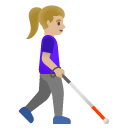
Appearance varies by platform and device. Google Noto, Twemoji, and OpenMoji are open-source.