👩🏿🤝👩🏾
The Emoji
Women Holding Hands: Dark Skin Tone, Medium-dark Skin Tone
U+1F469 U+1F3FF U+200D U+1F91D U+200D U+1F469 U+1F3FE · :women_holding_hands_dark_skin_tone_mediumdark_skin_tone:
Trend 58
Meaning layers
- interpretation
- Used to celebrate female friendships, LGBTQ+ relationships, Black girl magic, sisterhood, and solidarity between women of color. Often signals 'bestie energy' or romantic WLW (women loving women) vibes.
- tiktok usage
- Appears in 'girls supporting girls' content, WLW couple reveals, Black sisterhood montages, and POC friendship appreciation videos.
- irony level
- 1 / 10
Platform meanings
- meaning
- Celebrates female friendship and WLW relationships between women of color, used in duet videos, friendship reveals, and couple content.
- trend usage
- Common in 'meet my best friend' TikToks, Black girl friendship montages, WLW couple content, and POC solidarity videos.
- hashtags
- #blackgirlmagic#wlw#sistersforever#womenofcolor#blackbestfriends
- virality score
- 62 / 100
Cultural meanings
🇺🇸
Western / Gen-Z
Widely embraced as a symbol of WLW love and Black/brown sisterhood, celebrated in social media and LGBTQ+ spaces with high cultural resonance.
🇵🇰
Pakistan & India
Primarily interpreted as a symbol of close female friendship or sisterhood; the WLW romantic connotation is generally less emphasized due to cultural norms around same-sex relationships.
🌍
Middle East
Generally read as female friendship or sisterhood; romantic WLW interpretation is largely avoided in public contexts due to social and legal norms.
🌐
Global Neutral
Universally understood as two women holding hands, interpreted as friendship, solidarity, or partnership depending on cultural context.
🇧🇩
Bangladesh
Seen as a representation of close female friendship; cultural norms mean the WLW romantic dimension is rarely the primary interpretation.
🇱🇰
Sri Lanka
Interpreted as female companionship and sisterhood; women holding hands publicly is common as a friendship gesture, making this emoji feel natural in that context.
🇨🇳
China
Read primarily as close female friendship, as hand-holding between women is a common non-romantic gesture; the specific skin tone combination may be noted as representing Black or brown women.
🇯🇵
Japan
Seen as a kawaii friendship emoji when used platonically; in yuri (WLW) fandom spaces, it carries romantic connotations and is celebrated for its representation.
🇰🇷
South Korea
Used in female friendship contexts and in K-drama fan communities; increasingly embraced in LGBTQ+ Korean online spaces for WLW representation.
🇹🇼
Taiwan
Taiwan's relatively progressive LGBTQ+ environment means this emoji is more openly used for WLW romantic contexts alongside platonic sisterhood.
🇭🇰
Hong Kong
Used in both friendship and subtle WLW contexts; younger Hong Kong users in progressive online spaces are more likely to use it in LGBTQ+ contexts.
🇵🇭
Philippines
Close female friendships are celebrated openly, making this emoji popular for 'BFF' contexts; also gaining traction in Filipino LGBTQ+ communities.
🇮🇩
Indonesia
Primarily read as female friendship; romantic WLW interpretation is sensitive given cultural and religious context, though online LGBTQ+ communities use it affirmatingly.
🇹🇭
Thailand
Thailand's relatively open attitude toward gender diversity means this emoji is used in both friendship and romantic WLW contexts, especially among younger users.
🇻🇳
Vietnam
Interpreted mainly as close female friendship; the skin tones may specifically resonate with or be noted by Vietnamese users in discussions about racial diversity.
🇲🇾
Malaysia
Seen primarily as female friendship; WLW romantic usage exists in private LGBTQ+ spaces online but is less visible publicly due to cultural norms.
🇸🇦
Saudi Arabia
Interpreted as female friendship or sisterhood; same-sex romantic connotations are culturally sensitive and largely avoided in public digital contexts.
🇦🇪
UAE
Used in female friendship and sisterhood contexts; the multicultural nature of the UAE means the diverse skin tones may be specifically appreciated as representing diverse women.
🇪🇬
Egypt
Read as female solidarity and friendship; Islamic cultural norms mean the romantic WLW dimension is generally not the public interpretation.
🇹🇷
Turkey
Used among younger Turks to celebrate female friendship and, in LGBTQ+-friendly online spaces, WLW relationships; Pride Month usage has grown significantly.
🇮🇷
Iran
Primarily used for female friendship in public contexts; underground LGBTQ+ Iranian online communities use it quietly for WLW solidarity and representation.
🇳🇬
Nigeria
Strongly resonates as Black girl solidarity and sisterhood; the dark skin tones are particularly celebrated in Nigerian online spaces as representation of Black women.
🇿🇦
South Africa
Embraced both for Black female solidarity in the context of South Africa's racial history and for WLW representation in its relatively progressive legal environment for LGBTQ+ rights.
🇬🇧
UK & Ireland
Used for female friendship and WLW relationships; particularly resonant in British Black communities and LGBTQ+ POC spaces in London and major cities.
🇫🇷
France
Used for female friendship and WLW love; in France's context, the skin tone diversity may be noted in discussions about racial representation and laïcité.
🇩🇪
Germany
Embraced in German LGBTQ+ and feminist spaces for WLW and female solidarity representation; the specific skin tone combination is appreciated in diversity discussions.
🇪🇸
Spain & Italy
Used for female friendship and, in progressive urban LGBTQ+ spaces, for WLW relationships; the skin tone representation resonates in discussions about Afro-Latin and African diaspora communities.
🇧🇷
Brazil
Strongly resonates in Brazil's large and vibrant Black and Afro-Brazilian community for sisterhood; also widely used in WLW contexts given Brazil's large LGBTQ+ population.
🇲🇽
Mexico
Used for female friendship and solidarity; resonates in Afro-Mexican and indigenous feminist communities; growing WLW usage in LGBTQ+ digital spaces.
🌎
Latin America
Broadly used for female solidarity and sisterhood across Latin America; particularly resonant in Afro-Latin communities and growing LGBTQ+ digital spaces.
🇦🇺
Australia & NZ
Widely used for female friendship and WLW relationships in these progressive societies; the skin tone diversity is appreciated in multicultural urban communities.
How its meaning shifted
- 2010
This emoji did not exist in 2010; the concept of holding-hands emojis with skin tone modifiers and gender combinations was not yet part of Unicode.
- 2015
Still not available; basic couple and people emojis existed but diverse skin tone combinations for holding-hands sequences had not yet been added to the Unicode standard.
- 2020
Introduced as part of Unicode 12 and Emoji 12.0 expansions; began appearing in conversations about diverse representation, Black girl sisterhood, and WLW relationships for POC.
- 2026
Established as a key symbol of Black and brown female solidarity, WLW POC relationships, and intersectional feminism; widely used across all major platforms in relevant cultural contexts.
See it on every platform
Compare with
Adjacent emojis
Share & embed
Frequently asked
01What does the 👩🏿🤝👩🏾 Women Holding Hands: Dark Skin Tone, Medium-dark Skin Tone emoji mean?
Two women holding hands, with the left woman having dark skin tone and the right woman having medium-dark skin tone, representing female companionship, friendship, solidarity, or romantic partnership between women.
02What does 👩🏿🤝👩🏾 mean on TikTok?
Celebrates female friendship and WLW relationships between women of color, used in duet videos, friendship reveals, and couple content.
03What does 👩🏿🤝👩🏾 mean on WhatsApp?
Sent between close female friends of color to say 'we're ride-or-die,' 'this is us,' or to celebrate their friendship bond.
04What does 👩🏿🤝👩🏾 mean in Gen-Z slang?
Used to celebrate female friendships, LGBTQ+ relationships, Black girl magic, sisterhood, and solidarity between women of color. Often signals 'bestie energy' or romantic WLW (women loving women) vibes.
05Is the 👩🏿🤝👩🏾 emoji safe to use?
Represents female friendship, sisterhood, solidarity, and WLW romantic partnerships between women of color in an overwhelmingly positive and affirming way.
06What does 👩🏿🤝👩🏾 mean in texting?
Triggers feelings of community and acceptance, particularly resonant for Black and brown women who see themselves represented in the emoji pairing. Evokes safety and mutual support.
07What is the shortcode for 👩🏿🤝👩🏾?
The shortcode for Women Holding Hands: Dark Skin Tone, Medium-dark Skin Tone is :women_holding_hands_dark_skin_tone_mediumdark_skin_tone:
08What does 👩🏿🤝👩🏾 mean in dating?
WLW women of color use this to signal romantic interest or to celebrate their relationship publicly, often paired with heart emojis in dating app bios or DMs.
Safety & usage
- Safe meaning
- Represents female friendship, sisterhood, solidarity, and WLW romantic partnerships between women of color in an overwhelmingly positive and affirming way.
- Caution
- Rarely used in toxic contexts; occasionally co-opted in performative diversity or 'woke-washing' contexts that are criticized as hollow representation.
The WLW romantic interpretation may be culturally sensitive or legally restricted in certain countries; users in conservative regions should be aware of local norms when using this emoji publicly.
How it looks across platforms
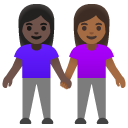


Appearance varies by platform and device. Google Noto, Twemoji, and OpenMoji are open-source.