👩🏾🤝👩🏿
The Emoji
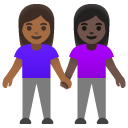
Women Holding Hands: Medium-dark Skin Tone, Dark Skin Tone
U+1F469 U+1F3FE U+200D U+1F91D U+200D U+1F469 U+1F3FF · :women_holding_hands_mediumdark_skin_tone_dark_skin_tone:
Trend 68
Meaning layers
- interpretation
- Used to celebrate female friendships, girl squads, WLW (women loving women) relationships, sisterhood, and Black girl magic. Often signals closeness between two women regardless of romantic or platonic context.
- tiktok usage
- Appears in videos celebrating Black girl friendships, WLW couples content, sisterhood montages, and 'bestie' compilations. Frequently used in captions for duo dances or friendship POVs.
- irony level
- 1 / 10
Platform meanings
- meaning
- Symbolizes female friendship, WLW love, and melanated sisterhood. Used to tag a bestie or girlfriend in duo content.
- trend usage
- Appears in trending sounds where female creators duet or stitch together, in 'black girl bestie' trends, and in WLW couple reveal videos.
- hashtags
- #blackgirlmagic#wlw#girlfriendgoals#sistersupport#melaninbestie
- virality score
- 72 / 100
Cultural meanings
🇺🇸
Western / Gen-Z
Strongly associated with WLW relationships and Black girl friendship aesthetics; celebrated openly and used as a pride and solidarity symbol by young women online.
🇵🇰
Pakistan & India
Interpreted primarily as platonic female friendship or sisterhood; the WLW romantic connotation is largely not acknowledged in mainstream usage due to cultural norms around same-sex relationships.
🌍
Middle East
Used almost exclusively to represent close female friendships or sisterly bonds; romantic interpretation between women is culturally sensitive and rarely acknowledged publicly.
🌐
Global Neutral
Broadly understood as two women of color holding hands in friendship or partnership; the specific skin tone combination signals melanin representation and diversity.
🇧🇩
Bangladesh
Seen as a symbol of female friendship and solidarity between women; the skin tones are less culturally significant, and romantic connotations are generally absent in mainstream use.
🇱🇰
Sri Lanka
Interpreted as female companionship or sisterhood; primarily used among younger, digitally active women to express closeness with a friend of similar background.
🇨🇳
China
Seen as two women who are close friends; public displays of hand-holding between women are culturally normalized as friendship in China, so it does not carry strong romantic coding.
🇯🇵
Japan
Interpreted as a symbol of female friendship or yuri (girls' love) depending on context; among anime and manga communities it may carry a romantic or emotional resonance.
🇰🇷
South Korea
Used to express female friendship or 'girl crush' energy; in K-pop fan communities it may reference OTPs (one true pairings) between female idols or characters.
🇹🇼
Taiwan
Given Taiwan's progressive LGBTQ+ stance, this emoji is used both for close female friendships and WLW relationships openly and positively.
🇭🇰
Hong Kong
Used for female friendship and, in younger or LGBTQ+-aware circles, to represent same-sex female relationships; skin tone diversity is noted positively.
🇵🇭
Philippines
Primarily represents close female friendship or 'besties' energy; used by young women in social media to celebrate their bond, with WLW meaning emerging in progressive online spaces.
🇮🇩
Indonesia
Interpreted as female friendship or sisterhood in mainstream usage; romantic meaning is less common due to conservative cultural norms, though LGBTQ+ communities use it more expressively.
🇹🇭
Thailand
Used for female friendship and, given Thailand's relatively open attitude toward same-sex relationships, also for WLW couples; Tom-Dee (Thai lesbian) communities use it positively.
🇻🇳
Vietnam
Seen as female friendship or sisterhood; hand-holding between women is culturally common as a platonic gesture, so it reads primarily as closeness rather than romance.
🇲🇾
Malaysia
Interpreted mainly as female friendship due to conservative social norms; LGBTQ+ connotations are present but rarely expressed publicly; skin tone diversity is appreciated.
🇸🇦
Saudi Arabia
Used exclusively to represent close female friendship or sisterhood; romantic interpretations are culturally off-limits publicly, but the emoji is used warmly among women for solidarity.
🇦🇪
UAE
Seen as female friendship, particularly among expat and younger communities who appreciate the skin tone representation; WLW meaning is underground in public-facing usage.
🇪🇬
Egypt
Represents close female friendship and sisterhood; the romantic reading is not mainstream, but the emoji is popular among young Egyptian women celebrating their bonds.
🇹🇷
Turkey
Used for female friendship and, among younger, progressive urban users, may carry WLW solidarity meaning; the skin tone combination is seen as a positive diversity signal.
🇮🇷
Iran
Primarily interpreted as female friendship; same-sex romantic meaning is culturally suppressed in public discourse, but the emoji is used among women to express close bonds privately.
🇳🇬
Nigeria
Strongly resonates as a Black sisterhood and female solidarity symbol; widely used to celebrate Black women supporting each other, with the dark skin tones carrying deep cultural pride.
🇿🇦
South Africa
Used to celebrate Black female friendship and solidarity, carrying connotations of Ubuntu and sisterhood; in LGBTQ+ communities it also represents WLW relationships openly.
🇬🇧
UK & Ireland
Used for both female friendship and WLW relationships; the specific skin tone combination is celebrated as a representation of diversity and multicultural Britain and Ireland.
🇫🇷
France
Interpreted as female friendship or couple emoji; in progressive and queer French online spaces it signals WLW relationships, while the skin tones are celebrated as reflecting la diversité.
🇩🇪
Germany
Used for female solidarity, friendship, and WLW relationships; Germany's open LGBTQ+ culture means the romantic connotation is widely understood and positively received.
🇪🇸
Spain & Italy
Primarily used for female friendship or 'amigas' energy; in younger, LGBTQ+-aware communities it signals WLW love; the skin tones add a multicultural dimension appreciated in cosmopolitan cities.
🇧🇷
Brazil
Widely used for female friendship and WLW relationships; Brazil's large and vocal LGBTQ+ community and diverse Afro-Brazilian population makes this emoji resonate strongly as both solidarity and pride.
🇲🇽
Mexico
Used for female friendship ('amigas para siempre') and, in progressive circles, WLW relationships; the darker skin tones resonate with mestiza and Indigenous pride movements.
🌎
Latin America
Broadly used to celebrate female friendship and sisterhood across Latin America; in LGBTQ+ communities it represents WLW love, and the skin tones nod to the region's racial diversity.
🇦🇺
Australia & NZ
Used for female friendship and WLW relationships; in Australia and New Zealand's multicultural and progressive contexts, the specific skin tones are recognized as a celebration of Indigenous and POC representation.
How its meaning shifted
- 2010
This specific emoji did not exist in 2010. Emoji sets were far more limited and lacked skin tone modifiers or gender-specific holding hands combinations entirely.
- 2015
Holding hands emojis began emerging but lacked diverse skin tone combinations; female same-sex couples had very limited or no dedicated emoji representation at this time.
- 2020
With Unicode expanding skin tone combinations for couple emojis, this specific pairing became available; usage grew quickly among Black women, WLW communities, and diversity advocates celebrating representation.
- 2026
Firmly established as a go-to emoji for Black female solidarity, WLW relationships, and melanin-celebrating friendship content; widely recognized across platforms and integrated naturally into everyday digital expression.
See it on every platform
Compare with
Adjacent emojis
Share & embed
Frequently asked
01What does the 👩🏾🤝👩🏿 Women Holding Hands: Medium-dark Skin Tone, Dark Skin Tone emoji mean?
Two women holding hands, with the left woman having a medium-dark skin tone and the right woman having a dark skin tone. Represents female friendship, solidarity, partnership, or romantic relationships between women.
02What does 👩🏾🤝👩🏿 mean on TikTok?
Symbolizes female friendship, WLW love, and melanated sisterhood. Used to tag a bestie or girlfriend in duo content.
03What does 👩🏾🤝👩🏿 mean on WhatsApp?
Sent between close female friends to express love, bond, or solidarity. Used to say 'we're inseparable' or 'we've got each other'.
04What does 👩🏾🤝👩🏿 mean in Gen-Z slang?
Used to celebrate female friendships, girl squads, WLW (women loving women) relationships, sisterhood, and Black girl magic. Often signals closeness between two women regardless of romantic or platonic context.
05Is the 👩🏾🤝👩🏿 emoji safe to use?
Represents female friendship, sisterhood, solidarity, and same-sex female relationships between women of color in a warm and positive way.
06What does 👩🏾🤝👩🏿 mean in texting?
This emoji taps into deep feelings of belonging and representation. For many users with darker skin tones, seeing their skin tone reflected in an emoji pair carries significant psychological validation and affirms identity and visibility.
07What is the shortcode for 👩🏾🤝👩🏿?
The shortcode for Women Holding Hands: Medium-dark Skin Tone, Dark Skin Tone is :women_holding_hands_mediumdark_skin_tone_dark_skin_tone:
08What does 👩🏾🤝👩🏿 mean in dating?
Used by WLW individuals to signal romantic interest, flirt subtly, or indicate a relationship status with another woman of similar or different skin tone.
Safety & usage
- Safe meaning
- Represents female friendship, sisterhood, solidarity, and same-sex female relationships between women of color in a warm and positive way.
- Caution
- No widely documented toxic usage; in extremely rare cases could be used mockingly in anti-LGBTQ+ or racially charged contexts, but this is not a common pattern.
Generally safe for all audiences. In culturally conservative regions, the WLW romantic interpretation may be considered sensitive. No known usage as a hate symbol or coded harmful meaning.
How it looks across platforms


Appearance varies by platform and device. Google Noto, Twemoji, and OpenMoji are open-source.