🧏🏻♂️
The Emoji
Deaf Man: Light Skin Tone
U+1F9CF U+1F3FB U+200D U+2642 U+FE0F · :deaf_man_light_skin_tone:
Trend 38
Meaning layers
- interpretation
- Used to say 'I'm not listening' or 'I can't hear you' sarcastically, often meaning someone is deliberately ignoring drama, bad takes, or criticism.
- tiktok usage
- Appears in comment sections when someone is blocking out negativity or calling out that they're done hearing a person's excuses.
- irony level
- 7 / 10
Platform meanings
- meaning
- Symbol of selective ignorance or empowered boundary-setting; 'I'm not listening to the negativity.'
- trend usage
- Appears in duets or stitches replying to controversial takes, signaling dismissal of the original creator's point.
- hashtags
- #deafawareness#notlistening#boundaries#ignorethehaters#deafcommunity
- virality score
- 42 / 100
Cultural meanings
🇺🇸
Western / Gen-Z
Widely used ironically to mean 'I'm not listening' or 'blocking out negativity,' detached from its literal Deaf representation in casual Gen Z discourse.
🇵🇰
Pakistan & India
Primarily understood literally to mean deafness; occasionally used in disability awareness posts on social media, though the sarcastic layer is gaining traction among urban youth.
🌍
Middle East
Used mostly in a literal or disability-awareness context; younger Arabic-speaking social media users are beginning to adopt the sarcastic 'not listening' meaning from Western trends.
🌐
Global Neutral
Universally recognized as representing deafness or hearing impairment; the secondary sarcastic meaning varies significantly by region and demographic.
🇧🇩
Bangladesh
Largely interpreted literally as a symbol of deafness; used in social awareness campaigns about hearing impairment and accessibility rights.
🇱🇰
Sri Lanka
Used in disability advocacy circles and awareness days; limited ironic use, mostly understood as a representation of Deaf individuals.
🇨🇳
China
The hand gesture near the ear is recognized but Deaf emoji representation is less culturally prominent; younger netizens on Weibo may adopt it sarcastically as '听不见 (can't hear).'
🇯🇵
Japan
Interpreted as representing the Deaf community; Japan has strong Deaf culture organizations, so this emoji appears in related awareness content though ironic use is minimal.
🇰🇷
South Korea
Used among K-pop fandoms to dramatically say they can't hear critics or antis; also used genuinely in disability representation discussions on platforms like KakaoTalk.
🇹🇼
Taiwan
Primarily literal in interpretation; disability rights groups in Taiwan use it in awareness campaigns on LINE and Instagram.
🇭🇰
Hong Kong
Used in both literal Deaf representation and informally in Cantonese social media to mean 'I'm tuning this out,' blending literal and ironic layers.
🇵🇭
Philippines
Widely understood as representing deafness; in casual Filipino social media, it's starting to be used humorously to mean 'hindi ko maririnig yan (I won't hear that).'
🇮🇩
Indonesia
Understood literally in Indonesian social media; disability awareness organizations use it in campaigns, while younger users on TikTok are picking up the dismissal meaning.
🇹🇭
Thailand
Mostly literal interpretation; Thai Deaf community advocates use it prominently on social platforms to celebrate Deaf culture and sign language.
🇻🇳
Vietnam
Used in disability awareness content; urban Vietnamese youth on TikTok and Facebook are beginning to adopt it with the ironic 'not listening' meaning.
🇲🇾
Malaysia
Understood as a symbol of Deaf identity; used in Malaysian sign language communities and occasionally in sarcastic contexts among younger Malay social media users.
🇸🇦
Saudi Arabia
Interpreted as a sign of deafness; used in disability rights and accessibility awareness posts on platforms like Twitter/X and Snapchat.
🇦🇪
UAE
Present in inclusive and disability-advocacy content; the multicultural social media landscape in UAE means both literal and ironic interpretations coexist.
🇪🇬
Egypt
Primarily literal; used in Egyptian disability awareness campaigns and occasionally in humor content to mean 'I'm choosing not to listen to this.'
🇹🇷
Turkey
Used in both disability representation and informally to mean 'kulağımı tıkıyorum (I'm plugging my ears)' in dismissive social media replies.
🇮🇷
Iran
Recognized as a disability symbol; used in Persian-language content around hearing impairment awareness and less commonly in sarcastic digital communication.
🇳🇬
Nigeria
Used in Nigerian social media mostly literally, though Naija humor culture is quick to adopt the 'not hearing the BS' sarcastic layer in Twitter and WhatsApp discourse.
🇿🇦
South Africa
Appears in disability inclusion and Deaf community content; South African youth on TikTok and Twitter use it sarcastically to dismiss drama.
🇬🇧
UK & Ireland
Common in the sarcastic 'not listening' usage alongside Deaf awareness; British humor culture embraces it in deadpan dismissal replies.
🇫🇷
France
Used in disability representation contexts and occasionally in French social media humor to mean 'je n'entends rien (I hear nothing)' in dismissive replies.
🇩🇪
Germany
Primarily used in disability advocacy and accessibility discussions; German social media culture uses it more literally than sarcastically.
🇪🇸
Spain & Italy
Both Spanish and Italian youth use it to dismiss unwanted opinions or drama, while Deaf communities in both countries use it for genuine representation.
🇧🇷
Brazil
Brazilian Twitter and TikTok culture fully embraces the sarcastic 'não tô nem aí (I don't care)' interpretation; also present in disability inclusion campaigns.
🇲🇽
Mexico
Used both literally in disability awareness content and sarcastically in Mexican humor to express deliberate ignorance of drama or criticism.
🌎
Latin America
Across Latin America, both the literal Deaf representation and the sarcastic 'not listening' usage are common, with younger users leaning heavily into the ironic layer.
🇦🇺
Australia & NZ
Australian and Kiwi users use it similarly to UK Gen Z — dismissive irony is common, while Deaf community organizations use it for genuine advocacy and visibility.
How its meaning shifted
- 2010
Emoji with skin tone modifiers and disability representations did not exist yet; this specific emoji was unavailable and the concept was not part of digital communication.
- 2015
Early emoji sets began including disability-related symbols; this specific emoji wasn't yet standardized, though general awareness of Deaf representation in tech was growing.
- 2020
Introduced and adopted primarily for Deaf representation and disability visibility; the COVID-19 pandemic increased awareness of accessibility needs including for the Deaf community.
- 2026
Dual-layered usage is fully mainstream — genuine Deaf identity expression coexists with ironic 'not listening' sarcasm; widely used in boundary-setting and dismissal contexts across all major platforms.
See it on every platform
Adjacent emojis
- Often confused with
- person gesturing okman tipping handperson facepalming
- Can replace
- muted speakerprohibitedperson gesturing no
Share & embed
Frequently asked
01What does the 🧏🏻♂️ Deaf Man: Light Skin Tone emoji mean?
A male-presenting person with light skin tone using a hand gesture near the ear to indicate deafness or hearing impairment.
02What does 🧏🏻♂️ mean on TikTok?
Symbol of selective ignorance or empowered boundary-setting; 'I'm not listening to the negativity.'
03What does 🧏🏻♂️ mean on WhatsApp?
Tells the other person their message was noted but willfully ignored, or humorously that the sender can't hear them.
04What does 🧏🏻♂️ mean in Gen-Z slang?
Used to say 'I'm not listening' or 'I can't hear you' sarcastically, often meaning someone is deliberately ignoring drama, bad takes, or criticism.
05Is the 🧏🏻♂️ emoji safe to use?
Represents Deaf or hard-of-hearing identity, disability pride, accessibility awareness, or the universal feeling of needing to block out noise.
06What does 🧏🏻♂️ mean in texting?
Psychologically represents boundary-setting behavior — the act of 'turning off' external noise as a self-protection mechanism, which resonates widely with younger audiences dealing with overstimulation.
07What is the shortcode for 🧏🏻♂️?
The shortcode for Deaf Man: Light Skin Tone is :deaf_man_light_skin_tone:
08What does 🧏🏻♂️ mean in dating?
Rarely used flirtatiously; occasionally deployed to play-pretend they didn't hear something embarrassing their crush said.
Safety & usage
- Safe meaning
- Represents Deaf or hard-of-hearing identity, disability pride, accessibility awareness, or the universal feeling of needing to block out noise.
- Caution
- Could be used mockingly toward someone who is actually Deaf, or deployed passive-aggressively to shut down valid concerns without engagement.
Context matters greatly — using this emoji to dismiss important accessibility requests or to mock Deaf individuals is harmful; sarcastic use should be reserved for clearly humorous contexts.
How it looks across platforms
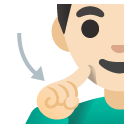
Appearance varies by platform and device. Google Noto, Twemoji, and OpenMoji are open-source.