👨🏿🏭
The Emoji
Man Factory Worker: Dark Skin Tone
U+1F468 U+1F3FF U+200D U+1F3ED · :man_factory_worker_dark_skin_tone:
Trend 32
Meaning layers
- interpretation
- Used to represent grinding hard, doing manual labor, or working unglamorous but necessary jobs. Sometimes used self-deprecatingly about working a 9-to-5 or any repetitive task.
- tiktok usage
- Appears in 'day in my life' factory or warehouse worker content, blue-collar pride videos, or ironically when someone is doing tedious work.
- irony level
- 4 / 10
Platform meanings
- meaning
- Represents hard manual labor, warehouse/factory life, or the blue-collar grind. Used sincerely by workers sharing their experiences.
- trend usage
- Featured in blue-collar pride trends, 'what I actually do' vs expectation videos, and working-class empowerment content.
- hashtags
- #BlueCollarPride#FactoryWorker#WorkingClass#GrindNeverStops#LaborDay
- virality score
- 38 / 100
Cultural meanings
🇺🇸
Western / Gen-Z
Used with blue-collar pride to push back against hustle culture glorifying only white-collar work; a badge of authenticity and real-world grind.
🇵🇰
Pakistan & India
Represents factory and mill workers, a large portion of the workforce; used respectfully to honor labor, often shared around Labour Day on May 1st.
🌍
Middle East
Seen as representing migrant factory workers who form a backbone of Gulf manufacturing; used in labor rights discussions and solidarity posts.
🌐
Global Neutral
Universally understood as a representation of a male factory or industrial worker with dark skin; used broadly for labor and workforce discussions.
🇧🇩
Bangladesh
Strongly associated with the garment and textile factory workforce, which is central to Bangladesh's economy; used with pride and sometimes in advocacy for workers' rights.
🇱🇰
Sri Lanka
Connected to industrial zone and export processing factory workers; used in labor rights contexts and worker welfare discussions.
🇨🇳
China
Represents the manufacturing workforce that drives the economy; used in discussions about industrial labor, factory conditions, and blue-collar workers.
🇯🇵
Japan
Associated with monozukuri (craftsmanship) culture; used to respectfully represent factory and precision manufacturing workers.
🇰🇷
South Korea
Represents industrial and manufacturing workers; used in labor union discussions and debates about working conditions in Korean factories.
🇹🇼
Taiwan
Connected to semiconductor and electronics manufacturing workers; used in tech industry labor discussions and working-class representation.
🇭🇰
Hong Kong
Reminiscent of the industrial worker heritage of Hong Kong; used nostalgically or in labor rights discussions.
🇵🇭
Philippines
Represents OFW (overseas Filipino workers) in factories abroad, as well as local manufacturing workers; carries themes of sacrifice and family support.
🇮🇩
Indonesia
Associated with the large manufacturing and textile workforce; used on Labor Day and in worker empowerment discussions.
🇹🇭
Thailand
Represents factory workers in automotive and electronics industries; used in labor welfare and working-class pride contexts.
🇻🇳
Vietnam
Strongly tied to the booming manufacturing sector; used to honor factory workers who power export industries.
🇲🇾
Malaysia
Represents manufacturing and electronics factory workers, including significant migrant worker populations; used in labor rights and diversity contexts.
🇸🇦
Saudi Arabia
Often associated with migrant factory and industrial workers; used in discussions about kafala system reform and worker rights.
🇦🇪
UAE
Tied to migrant industrial and construction workers who built much of the UAE's infrastructure; used in labor advocacy and awareness posts.
🇪🇬
Egypt
Represents industrial and textile factory workers; used around Labor Day and in union-related content.
🇹🇷
Turkey
Associated with factory and manufacturing workers in a country with a strong industrial tradition; used in labor union contexts.
🇮🇷
Iran
Represents factory workers and the industrial working class; used in labor protest and workers' rights discussions.
🇳🇬
Nigeria
Represents manufacturing and industrial workers in a growing economy; used to celebrate blue-collar labor and advocate for better working conditions.
🇿🇦
South Africa
Connected to mining and factory workers, carrying historical weight due to apartheid-era labor exploitation history; used with pride and solidarity.
🇬🇧
UK & Ireland
Represents the traditional working-class factory worker; used nostalgically for industrial heritage and in current blue-collar pride discussions.
🇫🇷
France
Associated with ouvrier (worker) culture and strong labor union traditions; used in strikes, labor discussions, and working-class solidarity posts.
🇩🇪
Germany
Connected to the proud tradition of Facharbeiter (skilled factory workers) and Germany's manufacturing excellence; used with respect and professional pride.
🇪🇸
Spain & Italy
Represents industrial and factory workers; used in labor discussions, especially around regional manufacturing hubs like northern Italy or Catalonia.
🇧🇷
Brazil
Tied to factory workers in the industrial heartland (e.g., São Paulo); used in labor movement content and working-class representation.
🇲🇽
Mexico
Represents maquiladora and factory workers; used in labor rights discussions, often in the context of cross-border manufacturing.
🌎
Latin America
Broadly represents the large manufacturing workforce across Latin America; used in worker solidarity and labor rights contexts.
🇦🇺
Australia & NZ
Represents blue-collar factory and industrial workers; used with respect in a culture that values tradies and manual laborers highly.
How its meaning shifted
- 2010
Emoji did not exist yet; factory worker representation was absent from emoji sets, reflecting a gap in diverse professional representation.
- 2015
Introduced as part of Unicode diversity expansions; initially used sparingly and mainly in literal contexts to represent factory or industrial workers.
- 2020
Gained traction during COVID-19 as essential worker appreciation grew; used in labor rights discussions, blue-collar pride content, and diversity conversations.
- 2026
Widely recognized symbol of blue-collar pride and working-class identity; used in labor advocacy, diversity in workforce representation, and authentic content by actual factory workers.
See it on every platform
Adjacent emojis
- Often confused with
- man mechanicman construction workerman technologist
Share & embed
Frequently asked
01What does the 👨🏿🏭 Man Factory Worker: Dark Skin Tone emoji mean?
A man working in a factory or industrial setting, depicted with dark skin tone. The emoji combines the man emoji, dark skin tone modifier, and factory worker emoji.
02What does 👨🏿🏭 mean on TikTok?
Represents hard manual labor, warehouse/factory life, or the blue-collar grind. Used sincerely by workers sharing their experiences.
03What does 👨🏿🏭 mean on WhatsApp?
Tells someone you're at work, doing manual labor, or that life is all work right now.
04What does 👨🏿🏭 mean in Gen-Z slang?
Used to represent grinding hard, doing manual labor, or working unglamorous but necessary jobs. Sometimes used self-deprecatingly about working a 9-to-5 or any repetitive task.
05Is the 👨🏿🏭 emoji safe to use?
Represents a factory or industrial worker with dark skin tone in a positive, inclusive, and professional context.
06What does 👨🏿🏭 mean in texting?
Evokes feelings of working-class identity, hard work, and resilience. For many users it signals pride in physical labor over white-collar prestige, sometimes carrying undertones of solidarity or fatigue.
07What is the shortcode for 👨🏿🏭?
The shortcode for Man Factory Worker: Dark Skin Tone is :man_factory_worker_dark_skin_tone:
08What does 👨🏿🏭 mean in dating?
Rarely used in flirting; occasionally used to signal 'I'm a hard worker and provider' in a humble, grounded way.
Safety & usage
- Safe meaning
- Represents a factory or industrial worker with dark skin tone in a positive, inclusive, and professional context.
- Caution
- Could potentially be used in racially insensitive contexts to stereotype dark-skinned individuals as only suited for manual labor, though this is uncommon.
The specific skin tone modifier makes it important to use respectfully; avoid using in ways that imply racial stereotyping about who belongs in factory work. Generally safe and positive.
How it looks across platforms
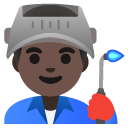


Appearance varies by platform and device. Google Noto, Twemoji, and OpenMoji are open-source.