👨🏽🏭
The Emoji
Man Factory Worker: Medium Skin Tone
U+1F468 U+1F3FD U+200D U+1F3ED · :man_factory_worker_medium_skin_tone:
Trend 22
Meaning layers
- interpretation
- Used to represent the working-class grind, blue-collar pride, or ironic commentary on being stuck in a 9-to-5 job. Sometimes used humorously to describe repetitive or mechanical daily tasks.
- tiktok usage
- Appears in 'I work at a factory' trend videos, working-class pride content, and sometimes ironically in 'this is my life now' relatable content about tedious jobs.
- irony level
- 5 / 10
Platform meanings
- meaning
- Represents working-class identity, factory job content, or ironic commentary on grinding through a repetitive job.
- trend usage
- Used in POV videos about factory work, labor rights TikToks, and working-class pride content. Also appears in 'day in my life' blue-collar content.
- hashtags
- #bluecollar#factorylife#workingclass#laborpride#grindculture
- virality score
- 28 / 100
Cultural meanings
🇺🇸
Western / Gen-Z
Often used ironically to describe being a cog in the machine or doing mindless work; also worn as blue-collar pride in working-class Gen Z circles resisting hustle culture aesthetics.
🇵🇰
Pakistan & India
Represents factory workers and labor migrants who work in industrial zones; carries respectful connotations of providing for family through hard work.
🌍
Middle East
Associated with South Asian migrant labor workers in Gulf manufacturing and construction sectors; can carry complex connotations of sacrifice and displacement.
🌐
Global Neutral
Universally understood as a male factory worker; widely used in labor and manufacturing contexts across all global platforms without cultural ambiguity.
🇧🇩
Bangladesh
Strongly associated with the garment and textile industry; evokes both pride in skilled labor and awareness of challenging work conditions in factories.
🇱🇰
Sri Lanka
Connected to export manufacturing and free-trade zone workers; often used in discussions about labor rights and industrial employment.
🇨🇳
China
Represents the massive manufacturing workforce; used with pride in industrial productivity contexts but also in discussions about worker conditions and automation.
🇯🇵
Japan
Associated with monozukuri (the art of making things) and manufacturing craftsmanship; used respectfully in contexts celebrating skilled industrial work.
🇰🇷
South Korea
Linked to the country's industrial backbone in steel, electronics, and automotive manufacturing; used in contexts celebrating economic development and worker identity.
🇹🇼
Taiwan
Associated with electronics and precision manufacturing industries; used in contexts of skilled blue-collar labor and industrial pride.
🇭🇰
Hong Kong
Less commonly used given the service-sector economy; when used, it references manufacturing heritage or Mainland China's industrial workforce.
🇵🇭
Philippines
Connected to OFW (Overseas Filipino Worker) narratives and factory workers abroad; used with themes of sacrifice, family support, and resilience.
🇮🇩
Indonesia
Represents a large manufacturing workforce particularly in textiles, electronics, and food processing; associated with labor movement discussions and working-class identity.
🇹🇭
Thailand
Associated with automotive and electronics manufacturing sectors; used in discussions about industrial workers and economic development.
🇻🇳
Vietnam
Strongly connected to the booming manufacturing sector; used with national pride around Vietnam's rise as a global factory hub and working-class identity.
🇲🇾
Malaysia
Associated with electronics and industrial manufacturing; used in contexts of migrant labor, working-class identity, and economic development.
🇸🇦
Saudi Arabia
Primarily associated with migrant factory workers from South Asia; used in discussions about kafala labor system and industrial workforce.
🇦🇪
UAE
Represents the large migrant worker population in industrial and construction sectors; complex cultural resonance around labor rights and expatriate identity.
🇪🇬
Egypt
Connected to factory workers in textile and food processing industries; used in labor discussions and working-class solidarity contexts.
🇹🇷
Turkey
Associated with a strong manufacturing and textile sector; used with working-class pride, particularly in industrial cities like Bursa and Gaziantep.
🇮🇷
Iran
Represents industrial workers in oil, steel, and manufacturing; used in labor rights discussions and contexts of working-class identity.
🇳🇬
Nigeria
Associated with emerging manufacturing sectors and artisan industries; used in discussions about industrial development and skilled labor.
🇿🇦
South Africa
Linked to mining and manufacturing industries; carries resonance with labor movement history and working-class struggle narratives.
🇬🇧
UK & Ireland
Connected to the industrial heritage and working-class culture; used nostalgically for the manufacturing past and in contemporary blue-collar pride contexts.
🇫🇷
France
Associated with French industrial workers and syndicalist culture; used in labor rights discussions and sometimes in references to gilets jaunes (yellow vest) movement solidarity.
🇩🇪
Germany
Strongly linked to the Facharbeiter (skilled worker) culture and automotive/engineering industries; used with high respect and pride in craftsmanship contexts.
🇪🇸
Spain & Italy
Connected to industrial workers in automotive, food processing, and manufacturing; used in labor union contexts and working-class cultural discussions.
🇧🇷
Brazil
Associated with factory workers in São Paulo's industrial belt and metalworkers' union history; used in labor rights and working-class solidarity discussions.
🇲🇽
Mexico
Connected to maquiladora factory culture and working-class identity near the US border; used in discussions about labor conditions and industrial employment.
🌎
Latin America
Broadly represents the industrial working class across Latin America; used in labor rights advocacy and contexts celebrating blue-collar resilience.
🇦🇺
Australia & NZ
Associated with manufacturing and trade workers; used with blue-collar pride and in discussions about union labor rights and fair wage campaigns.
How its meaning shifted
- 2010
Emoji did not exist yet; factory worker concepts were expressed through text-based descriptions or generic smiley faces in industrial work contexts.
- 2015
Shortly after introduction, used straightforwardly to represent factory or industrial workers with little ironic or cultural layering.
- 2020
Gained prominence during COVID-19 discussions about essential workers; used in contexts of labor appreciation and working-class visibility movements.
- 2026
Used across labor rights movements, automation anxiety discussions, and blue-collar pride content; carries both earnest and ironic dimensions depending on platform and context.
See it on every platform
Adjacent emojis
- Opposite
- man in suitlaptopcrown
- Often confused with
- man in hard hatconstruction workerman technologist
- Can replace
- construction workergearhammer
Share & embed
Frequently asked
01What does the 👨🏽🏭 Man Factory Worker: Medium Skin Tone emoji mean?
A man with medium skin tone depicted as a factory worker, wearing a hard hat and work uniform, representing industrial labor and manufacturing occupations.
02What does 👨🏽🏭 mean on TikTok?
Represents working-class identity, factory job content, or ironic commentary on grinding through a repetitive job.
03What does 👨🏽🏭 mean on WhatsApp?
Signals that someone is at work, doing manual labor, or describing a hard day's work to family or friends.
04What does 👨🏽🏭 mean in Gen-Z slang?
Used to represent the working-class grind, blue-collar pride, or ironic commentary on being stuck in a 9-to-5 job. Sometimes used humorously to describe repetitive or mechanical daily tasks.
05Is the 👨🏽🏭 emoji safe to use?
Represents factory workers, industrial labor, manufacturing occupations, and working-class identity in a completely benign and professional context.
06What does 👨🏽🏭 mean in texting?
Evokes feelings of hard work and perseverance but can also carry undertones of economic struggle. Psychologically linked to dignity-of-labor narratives and class identity.
07What is the shortcode for 👨🏽🏭?
The shortcode for Man Factory Worker: Medium Skin Tone is :man_factory_worker_medium_skin_tone:
08What does 👨🏽🏭 mean in dating?
Occasionally used to signal being hardworking and dependable — 'I provide' energy. Rarely used as a direct flirt tool.
Safety & usage
- Safe meaning
- Represents factory workers, industrial labor, manufacturing occupations, and working-class identity in a completely benign and professional context.
- Caution
- Rarely weaponized, but occasionally used condescendingly in class-based insults implying someone has a low-status or unskilled job.
Generally safe for all audiences. In rare cases may be used in classist or discriminatory contexts to demean blue-collar workers, but this is uncommon.
How it looks across platforms
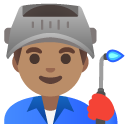


Appearance varies by platform and device. Google Noto, Twemoji, and OpenMoji are open-source.