👵🏿
The Emoji
Old Woman: Dark Skin Tone
U+1F475 U+1F3FF · :old_woman_dark_skin_tone:
Trend 35
Meaning layers
- interpretation
- Used to represent grandmothers, wise elders, or ironically to call someone or oneself 'old' in a playful way. Also deployed in self-deprecating humor about feeling ancient.
- tiktok usage
- Appears in 'POV: me at 30' jokes, 'grandma aesthetic' trends, or when reacting to something generationally dated.
- irony level
- 5 / 10
Platform meanings
- meaning
- Represents grandmothers, aging humor, or intergenerational content; used in skits and POV videos about getting old.
- trend usage
- Featured in 'granfluencer' content, grandma cooking trends, and self-deprecating age jokes by young creators.
- hashtags
- #grandmavibes#elderlyhumor#grandmacore#aginglikeafinewoman#grandmatiktok
- virality score
- 42 / 100
Cultural meanings
🇺🇸
Western / Gen-Z
Used playfully in meme culture to represent 'acting old' or sincerely in tribute posts for Black grandmothers; the dark skin tone modifier is appreciated for inclusive representation.
🇵🇰
Pakistan & India
Represents the revered 'nani' or 'dadi' figure; the dark skin tone may reflect South Asian complexions and is used sincerely in family-related messages.
🌍
Middle East
Symbolizes the respected grandmother ('teta' or 'sitto') and matriarch figure; used sincerely in family and religious contexts.
🌐
Global Neutral
Universally understood as an elderly woman; the dark skin tone adds specificity and is seen positively as inclusive representation.
🇧🇩
Bangladesh
Used to represent 'nana' or 'dadi' and is embraced for reflecting South Asian skin tones in family chats.
🇱🇰
Sri Lanka
Represents respected elder women ('aachchi'); dark skin tone resonates with Sri Lankan complexions and is used in family tribute messages.
🇨🇳
China
Seen as a straightforward representation of an elderly woman ('nǎi nai' or 'wài pó'); skin tone specificity is less culturally emphasized but the emoji is used sincerely.
🇯🇵
Japan
Used to represent 'obaachan' (grandmother); the dark skin tone is less common in Japanese contexts but recognized globally as inclusive.
🇰🇷
South Korea
Represents '할머니' (halmeoni); used sincerely in family contexts; dark skin tone is noted as a global diversity feature.
🇹🇼
Taiwan
Refers to 'ama' (grandma); skin tone modifier appreciated as a diversity feature; used in wholesome family digital communication.
🇭🇰
Hong Kong
Represents elderly women in family chats; used sincerely in Cantonese-speaking communities to refer to grandmothers.
🇵🇭
Philippines
Represents 'lola' (grandmother) and is widely used in Filipino family group chats; the dark skin tone reflects Filipino complexions positively.
🇮🇩
Indonesia
Used to represent 'nenek' (grandmother); dark skin tone resonates with Indonesian skin tones and is embraced in family messaging.
🇹🇭
Thailand
Represents 'yai' (maternal grandmother); used sincerely in family chats; dark skin tone is recognized as global representation.
🇻🇳
Vietnam
Represents 'bà' (grandmother); commonly used in family tribute messages; diversity modifier is appreciated by younger Vietnamese users.
🇲🇾
Malaysia
Used in family chats to represent 'nenek'; dark skin tone reflects Malay and Orang Asli complexions and is embraced as inclusive.
🇸🇦
Saudi Arabia
Represents the venerated 'teta' or 'jaddah' figure; used sincerely in family WhatsApp groups with deep cultural respect for elder women.
🇦🇪
UAE
Reflects the respected elder woman figure in Emirati culture; used in family contexts and intergenerational tribute posts.
🇪🇬
Egypt
Represents the beloved 'teta'; used warmly in family chats and social media posts honoring elder women.
🇹🇷
Turkey
Symbolizes 'büyükanne' or 'nine'; used in sincere family contexts and nostalgic posts about grandmother figures.
🇮🇷
Iran
Represents 'maman bozorg'; used sincerely in family messaging apps; deeply tied to notions of cultural wisdom and domesticity.
🇳🇬
Nigeria
Highly resonant — represents the esteemed African grandmother figure; dark skin tone is particularly meaningful and representative for Nigerian users.
🇿🇦
South Africa
Represents 'gogo' or 'ouma'; dark skin tone is affirming and widely embraced in South African Black communities as accurate representation.
🇬🇧
UK & Ireland
Used sincerely to represent grandmothers; among younger users, also used humorously to call someone old-fashioned; dark skin tone reflects Black British communities.
🇫🇷
France
Represents 'mamie'; used sincerely in family contexts; dark skin tone is embraced by French Afro-Caribbean communities as visible representation.
🇩🇪
Germany
Used to represent 'Oma'; dark skin tone noted as a diversity inclusion marker; used sincerely in elder-tribute posts.
🇪🇸
Spain & Italy
Represents 'abuela' or 'nonna'; very warmly received as these cultures deeply revere elder women; dark skin tone embraced by Afro-Latino and African diaspora communities.
🇧🇷
Brazil
Represents 'vovó'; strongly resonates in Afro-Brazilian communities where dark skin tone is affirming and celebratory.
🇲🇽
Mexico
Represents 'abuelita'; dark skin tone resonates with Indigenous and Afro-Mexican communities; deeply associated with warmth and traditional wisdom.
🌎
Latin America
Broadly represents the beloved 'abuela' figure across Latin America; dark skin tone embraced by Afro-Latinx communities as authentic representation.
🇦🇺
Australia & NZ
Used sincerely for grandmothers; dark skin tone resonates with Aboriginal, Torres Strait Islander, and Pacific Islander communities as meaningful representation.
How its meaning shifted
- 2010
Emoji diversity was nonexistent at this point; no skin tone modifier was available; a generic yellow-toned old woman emoji was the only option.
- 2015
Skin tone modifiers introduced via Unicode 8.0; the dark skin tone old woman emoji became available, primarily used sincerely in family and elder-tribute contexts.
- 2020
Gained broader use in meme culture and GenZ ironic humor about aging; also increasingly used in diversity and inclusion conversations on social media.
- 2026
Widely recognized as both a sincere tribute emoji and an ironic humor device; embraced in Black grandma appreciation content, granfluencer trends, and intergenerational social media storytelling.
See it on every platform
Compare with
Adjacent emojis
Share & embed
Frequently asked
01What does the 👵🏿 Old Woman: Dark Skin Tone emoji mean?
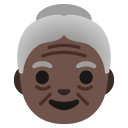
Depicts an elderly woman with dark skin tone, shown with gray or white hair, often with wrinkles, representing an older female person of dark complexion.
02What does 👵🏿 mean on TikTok?
Represents grandmothers, aging humor, or intergenerational content; used in skits and POV videos about getting old.
03What does 👵🏿 mean on WhatsApp?
Commonly used to refer to one's grandmother or an older female relative in casual family chats.
04What does 👵🏿 mean in Gen-Z slang?
Used to represent grandmothers, wise elders, or ironically to call someone or oneself 'old' in a playful way. Also deployed in self-deprecating humor about feeling ancient.
05Is the 👵🏿 emoji safe to use?
Representation of an elderly dark-skinned woman; used in family tribute posts, diversity conversations, and wholesome elder-appreciation content.
06What does 👵🏿 mean in texting?
Evokes feelings of familial love, intergenerational connection, and cultural reverence for elders, while also touching on anxieties around aging in younger users.
07What is the shortcode for 👵🏿?
The shortcode for Old Woman: Dark Skin Tone is :old_woman_dark_skin_tone:
08What does 👵🏿 mean in dating?
Rarely used in flirting; occasionally sent jokingly when someone acts 'old-fashioned' or overly cautious in a relationship.
Safety & usage
- Safe meaning
- Representation of an elderly dark-skinned woman; used in family tribute posts, diversity conversations, and wholesome elder-appreciation content.
- Caution
- Could be weaponized in ageist or colorist harassment, though this is uncommon; occasionally used to demean someone as 'old and irrelevant.'
Generally safe; monitor for ageist context or colorist deployment in harassment situations; no significant documented misuse trends.
How it looks across platforms


Appearance varies by platform and device. Google Noto, Twemoji, and OpenMoji are open-source.