🧑🦯➡️
The Emoji
Person With White Cane Facing Right
U+1F9D1 U+200D U+1F9AF U+200D U+27A1 U+FE0F · :person_with_white_cane_facing_right:
Trend 22
Meaning layers
- interpretation
- Used to represent navigating life blindly, moving forward without a clear vision, or stumbling through situations without full awareness. Sometimes used humorously to say 'I have no idea where I'm going but I'm going.'
- tiktok usage
- Appears in transition videos, 'life be like' content, and humor about making decisions without enough information. Used in captions like 'me entering adulthood 🧑🦯➡️'
- irony level
- 6 / 10
Platform meanings
- meaning
- Represents moving forward without clarity or direction, often used humorously in relatable content about life confusion.
- trend usage
- Used in POV videos, 'adulting' humor, and transition effects where someone walks into an uncertain or chaotic situation.
- hashtags
- #adulting#blindlyconfident#lifebelike#navigatinglife#disabilityrepresentation
- virality score
- 28 / 100
Cultural meanings
🇺🇸
Western / Gen-Z
Used both as genuine disability representation and ironically to describe moving through life without a clear plan. Fairly well understood in both contexts.
🇵🇰
Pakistan & India
Primarily interpreted literally as representing a blind or visually impaired person. Less commonly used ironically; often seen in disability awareness conversations.
🌍
Middle East
Understood as a symbol of disability and is used respectfully in awareness content. The directional facing is sometimes noted for navigational symbolism.
🌐
Global Neutral
Universally recognized as representing a person with a visual impairment using a white cane. The rightward direction adds a sense of purposeful movement.
🇧🇩
Bangladesh
Used mainly in literal disability contexts and accessibility advocacy. Ironic or meme usage is minimal.
🇱🇰
Sri Lanka
Primarily understood as a disability symbol. Occasionally used in social media posts about navigating difficulties in daily life.
🇨🇳
China
Used in disability awareness contexts and WeChat posts about accessibility. The symbolic reading of 'moving forward despite obstacles' resonates culturally.
🇯🇵
Japan
Recognized as a disability symbol consistent with Japan's accessible signage culture. Used respectfully in educational and social welfare contexts.
🇰🇷
South Korea
Used in disability representation content and occasionally in humor about 'blindly' following trends, consistent with K-internet humor styles.
🇹🇼
Taiwan
Understood as a disability representation emoji. Progressive online communities also use it to discuss navigating social or political uncertainty.
🇭🇰
Hong Kong
Used in disability advocacy and occasionally in commentary about navigating uncertain political or social landscapes with limited visibility.
🇵🇭
Philippines
Primarily used literally in disability awareness. In casual chat, it sometimes appears humorously when someone admits to being lost or uninformed.
🇮🇩
Indonesia
Seen mostly in disability awareness and social welfare content. Ironic usage is emerging in younger internet communities.
🇹🇭
Thailand
Used in disability representation posts and accessibility discussions. Occasionally appears in humorous content about being lost or confused.
🇻🇳
Vietnam
Primarily literal usage in disability contexts. Some younger users employ it metaphorically in posts about navigating life challenges.
🇲🇾
Malaysia
Used in disability awareness campaigns and inclusivity conversations. Dual-language social media communities use it in both literal and figurative contexts.
🇸🇦
Saudi Arabia
Used in disability awareness and charitable content aligned with Islamic values of caring for those with disabilities. Directional facing resonates with purposeful movement.
🇦🇪
UAE
Appears in inclusive design and smart city accessibility discussions. Used respectfully in multicultural social media communities.
🇪🇬
Egypt
Used in disability awareness posts. In humor contexts, it appears in content about proceeding without knowledge — common in Egyptian social media comedy.
🇹🇷
Turkey
Used in disability representation and occasionally in political commentary about 'governing blindly.' Meme usage is moderate among younger users.
🇮🇷
Iran
Used primarily in disability awareness contexts. Metaphorical usage about navigating restrictions or uncertainty appears in more liberal online communities.
🇳🇬
Nigeria
Appears in disability advocacy content and motivational posts about pushing forward despite hardship. The resilience angle resonates strongly.
🇿🇦
South Africa
Used in disability rights discussions and inclusive design advocacy. Also appears in content about navigating complex social or economic challenges.
🇬🇧
UK & Ireland
Used both literally for disability representation and ironically in British humor about blundering forward without a clue. Dry wit pairs well with this emoji.
🇫🇷
France
Used in disability awareness and accessibility policy discussions. French internet users occasionally use it in existentialist humor about navigating life without meaning.
🇩🇪
Germany
Primarily used in formal accessibility and disability rights content. Precise German internet culture treats it more literally than most Western counterparts.
🇪🇸
Spain & Italy
Used in disability advocacy and occasionally in dramatic, expressive social media posts about navigating confusing situations or life chaos.
🇧🇷
Brazil
Used in disability awareness and also in humor about going forward despite having no idea what's happening — a very relatable sentiment in Brazilian social media.
🇲🇽
Mexico
Appears in disability representation content and humorous posts about life's unpredictability. Paired with self-deprecating captions about uncertainty.
🌎
Latin America
Broadly used for disability representation across Latin America, with secondary usage in humor about navigating complex social or economic realities.
🇦🇺
Australia & NZ
Used in disability awareness and inclusivity campaigns. Also used in casual self-deprecating humor, consistent with laid-back antipodean internet culture.
How its meaning shifted
- 2010
This specific emoji variant did not exist in 2010. General disability representation online was minimal and text-based.
- 2015
Basic disability emojis were emerging but this directional variant did not yet exist. Accessibility emoji advocacy was gaining momentum.
- 2020
The directional variant was introduced as part of Unicode's expanded ZWJ sequence support. Initial usage was primarily literal — disability representation and advocacy.
- 2026
Dual usage is well established: literal disability representation in awareness content and ironic/humorous usage among Gen Z to describe navigating uncertainty. Accessibility emoji usage overall has normalized.
See it on every platform
Adjacent emojis
- Often confused with
- person walkingperson runningpedestrian
Share & embed
Frequently asked
01What does the 🧑🦯➡️ Person With White Cane Facing Right emoji mean?
A person using a white cane for navigation, facing right. The white cane is an internationally recognized symbol of blindness or visual impairment.
02What does 🧑🦯➡️ mean on TikTok?
Represents moving forward without clarity or direction, often used humorously in relatable content about life confusion.
03What does 🧑🦯➡️ mean on WhatsApp?
Often used to indicate someone is navigating a confusing situation or proceeding without full information. Also used in genuine disability-related conversations.
04What does 🧑🦯➡️ mean in Gen-Z slang?
Used to represent navigating life blindly, moving forward without a clear vision, or stumbling through situations without full awareness. Sometimes used humorously to say 'I have no idea where I'm going but I'm going.'
05Is the 🧑🦯➡️ emoji safe to use?
Representation of a blind or visually impaired person navigating independently with a white cane. Used in disability awareness, accessibility advocacy, and self-representation.
06What does 🧑🦯➡️ mean in texting?
The cane symbolizes adaptive coping — moving forward despite limitation. It evokes both admiration for independence and empathy for struggle, reflecting the psychological tension between vulnerability and agency.
07What is the shortcode for 🧑🦯➡️?
The shortcode for Person With White Cane Facing Right is :person_with_white_cane_facing_right:
08What does 🧑🦯➡️ mean in dating?
Rarely used in flirting. Could be used self-deprecatingly like 'I'm blind when it comes to reading signs 🧑🦯➡️' to acknowledge obliviousness to romantic cues.
Safety & usage
- Safe meaning
- Representation of a blind or visually impaired person navigating independently with a white cane. Used in disability awareness, accessibility advocacy, and self-representation.
- Caution
- Can be used mockingly to imply someone is 'blind' or stupid in an ableist context, though this is uncommon.
Using this emoji to mock someone's lack of awareness or intelligence can be considered ableist. Context matters — ironic usage should be mindful of disability communities.
How it looks across platforms
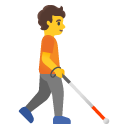
Appearance varies by platform and device. Google Noto, Twemoji, and OpenMoji are open-source.