🦸🏿
The Emoji
Superhero: Dark Skin Tone
U+1F9B8 U+1F3FF · :superhero_dark_skin_tone:
Trend 68
Meaning layers
- interpretation
- Used to hype someone up as a legend, a real one, or someone doing the most for their community. Often self-applied ironically or genuinely to signal Black excellence, resilience, or going above and beyond for others.
- tiktok usage
- Appears in videos celebrating Black creators, activists, and public figures. Also used in 'main character' energy content and self-empowerment montages.
- irony level
- 3 / 10
Platform meanings
- meaning
- Symbol of Black heroism, community uplift, and main character energy. Used to celebrate creators, activists, and everyday legends.
- trend usage
- Appears in trending sounds celebrating Black joy and resilience, POV videos where the user plays a hero, and duets hyping up someone's achievements.
- hashtags
- #BlackExcellence#SuperheroVibes#BlackTikTok#RealOnes#HeroMoment
- virality score
- 72 / 100
Cultural meanings
🇺🇸
Western / Gen-Z
Strongly associated with Black excellence, self-empowerment, and representation politics; used authentically and ironically depending on context. Widely understood as a celebration of heroism tied to Black identity.
🇵🇰
Pakistan & India
Less culturally specific skin tone meaning; interpreted primarily as a superhero symbol. Dark skin tone may carry colorism-related subtext in some communities, making its use more complex.
🌍
Middle East
Understood as a heroic symbol; skin tone specificity is acknowledged but the primary reading is admiration and strength. Used in pan-Arab youth spaces to celebrate athletes and cultural figures.
🌐
Global Neutral
Universally read as a symbol of heroism, courage, and admiration. The dark skin tone adds a layer of representation that is broadly recognized as positive across most global contexts.
🇧🇩
Bangladesh
Primarily read as a superhero or hero figure. Skin tone representation discourse is less prominent culturally, so it functions mainly as an expression of admiration or praise.
🇱🇰
Sri Lanka
Used to express heroic admiration, especially in cricket culture when celebrating standout players. Skin tone nuance is generally not deeply discussed in mainstream usage.
🇨🇳
China
Superhero imagery is popular via Marvel and DC media; the dark skin tone modifier may be less culturally parsed. Used broadly to signal heroism or fan appreciation for characters like Black Panther.
🇯🇵
Japan
Associated with Western superhero pop culture and cosplay communities. The skin tone modifier is noted as a representation choice; used in fandom and empowerment contexts by diverse communities.
🇰🇷
South Korea
Connected to Marvel fandom and K-pop adjacent hero aesthetics. Increasingly used by younger Koreans aware of global diversity discourse to signal allyship or celebrate Black artists they admire.
🇹🇼
Taiwan
Used in fandom contexts for superhero media; skin tone awareness is growing among younger, globally connected users who understand its representational significance.
🇭🇰
Hong Kong
Popular in Marvel and DC fan communities. Used by younger demographics who are internationally connected to signal admiration or celebration of heroic figures.
🇵🇭
Philippines
Strongly associated with superhero culture from both Western and local komiks traditions. Used enthusiastically to hype up community figures, athletes, and online personalities.
🇮🇩
Indonesia
Used to celebrate national heroes, athletes, and local public figures doing admirable work. Growing awareness of skin tone representation among younger, social-media-savvy users.
🇹🇭
Thailand
Primarily understood as a hero or strong person symbol. Some colorism sensitivity exists culturally, but the emoji is generally used positively to express admiration.
🇻🇳
Vietnam
Associated with bravery and heroic action. Used in celebratory contexts for athletes, soldiers, and community leaders. Skin tone representation awareness is growing among younger generations.
🇲🇾
Malaysia
Used across diverse ethnic communities to celebrate heroic figures. The dark skin tone resonates strongly with the Malay and Indian Malaysian communities as a representation symbol.
🇸🇦
Saudi Arabia
Used to express admiration for heroic figures; superhero culture is popular via streaming platforms. Skin tone representation is understood but less politically charged in mainstream usage.
🇦🇪
UAE
In the UAE's multicultural environment, the dark skin tone emoji is well understood and used across diverse expat and local communities to celebrate heroes and community contributors.
🇪🇬
Egypt
Associated with strength and heroism; used to praise athletes, national figures, and community leaders. The dark skin tone is relatable to many Egyptians and celebrated in some youth spaces.
🇹🇷
Turkey
Primarily read as a superhero symbol. Used to celebrate athletes, soldiers, and public figures. Skin tone specificity is noted but not a dominant part of the cultural conversation.
🇮🇷
Iran
Understood in the context of superhero media popular via streaming. Used by younger Iranians to express admiration and heroic praise; representation discourse is present in diaspora communities.
🇳🇬
Nigeria
Deeply resonant symbol of Black excellence and pride. Widely used by Nigerian youth on social media to celebrate community heroes, artists, athletes, and activists.
🇿🇦
South Africa
Carries strong cultural weight as a celebration of Black identity and heroism. Used in contexts celebrating Ubuntu philosophy, anti-apartheid legacy, and contemporary Black excellence.
🇬🇧
UK & Ireland
Used by Black British and Irish communities with strong representational pride. Also used broadly by young people to hype up friends regardless of skin tone, often with awareness of its specificity.
🇫🇷
France
Used in Afro-French communities to celebrate Black identity and heroism. France's complex relationship with communautarisme means skin tone emojis are sometimes navigated carefully in public discourse.
🇩🇪
Germany
Growing recognition of its representational significance. Used in Afro-German communities and among allies to celebrate Black heroes; superhero culture provides an accessible entry point.
🇪🇸
Spain & Italy
Associated primarily with superhero culture. Used by Afro-Spanish and Afro-Italian communities to assert representational pride; broader awareness is growing through social media.
🇧🇷
Brazil
In Brazil's racially complex society, this emoji is used powerfully to celebrate Black Brazilian identity and Afro-Brazilian cultural pride, especially during events like the Dia da Consciência Negra.
🇲🇽
Mexico
Used to celebrate heroic figures and community leaders. Awareness of skin tone representation is growing among younger Mexicans connected to global social justice conversations.
🌎
Latin America
Across Latin America, used by Afro-descendant communities to celebrate identity and pride. Broader usage as a general heroism symbol is also common among non-Black users.
🇦🇺
Australia & NZ
Used in Indigenous and Black communities, as well as by Pacific Islander communities, to celebrate cultural heroes. Broadly understood as a representation-positive choice by younger generations.
How its meaning shifted
- 2010
This specific emoji did not exist in 2010. Superhero emojis and skin tone modifiers were not yet part of the Unicode standard, so heroic sentiment was expressed through 💪 or ⚡.
- 2015
Skin tone modifiers were introduced in Unicode 8.0 (2015), but the superhero emoji itself came later. Users were beginning to explore diverse emoji options as representation conversations grew online.
- 2020
Gained significant traction following the Black Lives Matter movement's resurgence and the cultural impact of Black Panther (2018) and Into the Spider-Verse (2018). Used heavily in celebration of Black excellence and community heroism.
- 2026
Firmly established as a symbol of Black empowerment, community heroism, and representation. Used authentically in cultural celebration contexts and understood across platforms with nuanced appreciation for its skin tone specificity.
See it on every platform
Adjacent emojis
- Often confused with
- person in capemage dark skin toneguard dark skin tone
- Can replace
- raised fist dark skin tonestarcrown
Share & embed
Frequently asked
01What does the 🦸🏿 Superhero: Dark Skin Tone emoji mean?
A superhero character with dark skin tone, depicted wearing a cape or costume associated with heroic figures. The dark skin tone modifier (🏿) is applied to the base superhero emoji 🦸 to represent darker complexions.
02What does 🦸🏿 mean on TikTok?
Symbol of Black heroism, community uplift, and main character energy. Used to celebrate creators, activists, and everyday legends.
03What does 🦸🏿 mean on WhatsApp?
Calling someone a hero in a group chat or one-on-one conversation, often after they helped solve a problem or came through in a clutch moment.
04What does 🦸🏿 mean in Gen-Z slang?
Used to hype someone up as a legend, a real one, or someone doing the most for their community. Often self-applied ironically or genuinely to signal Black excellence, resilience, or going above and beyond for others.
05Is the 🦸🏿 emoji safe to use?
Celebration of heroism, Black excellence, community pride, admiration for someone who went above and beyond, and positive representation of dark skin tone identity.
06What does 🦸🏿 mean in texting?
Activates feelings of representation and belonging, particularly for users with darker skin tones. Seeing oneself in heroic imagery is psychologically affirming and linked to positive self-concept and identity strength.
07What is the shortcode for 🦸🏿?
The shortcode for Superhero: Dark Skin Tone is :superhero_dark_skin_tone:
08What does 🦸🏿 mean in dating?
Used to call a crush 'my hero' or tell them they saved the day — often paired with a compliment after someone does something sweet or protective.
Safety & usage
- Safe meaning
- Celebration of heroism, Black excellence, community pride, admiration for someone who went above and beyond, and positive representation of dark skin tone identity.
- Caution
- In rare cases, can be used mockingly or in racially coded negative commentary. May appear in bad-faith posts that ironically 'celebrate' someone to subtly undermine them.
Generally safe and positive. Users should be aware that skin tone emojis can sometimes be appropriated or used inauthentically by non-Black users in ways that feel performative or tokenizing to Black communities.
How it looks across platforms
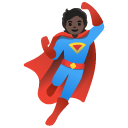


Appearance varies by platform and device. Google Noto, Twemoji, and OpenMoji are open-source.