👷🏻♀️
The Emoji
Woman Construction Worker: Light Skin Tone
U+1F477 U+1F3FB U+200D U+2640 U+FE0F · :woman_construction_worker_light_skin_tone:
Trend 48
Meaning layers
- interpretation
- Used to signal hustle culture, girlboss energy, or 'building something' metaphorically — often posted when grinding on a project, career goal, or personal glow-up.
- tiktok usage
- Appears in 'that girl' routines, productivity vlogs, and small business content to signal hard work and independence.
- irony level
- 3 / 10
Platform meanings
- meaning
- Symbol of hustle, female empowerment, and 'building your empire' content.
- trend usage
- Used in #grindset and #girlboss content, small business TikTok, and productivity motivation videos.
- hashtags
- #girlboss#smallbusiness#hustleculture#womenwhobuild#workhard
- virality score
- 52 / 100
Cultural meanings
🇺🇸
Western / Gen-Z
Widely used as a girlboss or hustle symbol; also deployed ironically when 'building' intangible things like trauma or excuses.
🇵🇰
Pakistan & India
Gaining visibility as a symbol of female empowerment in labor; used proudly in urban feminist discourse but less common in everyday casual chat.
🌍
Middle East
Used cautiously in feminist and women's rights contexts; in progressive circles signals support for women entering the workforce in non-traditional roles.
🌐
Global Neutral
Universally understood as a female construction worker or woman doing physical skilled work; broadly positive connotation.
🇧🇩
Bangladesh
Carries significance in a country with a large female labor workforce; used to celebrate working women in garment, construction, and industrial sectors.
🇱🇰
Sri Lanka
Used to represent hardworking women in skilled labor; resonates in urban areas discussing gender equity in the workforce.
🇨🇳
China
Associated with the cultural legacy of women workers (nü gongren); used in labor pride and feminist WeChat/Weibo content.
🇯🇵
Japan
Rare in casual use; when used, signals appreciation for joshi-kosei (career women) bucking gender norms in construction or engineering.
🇰🇷
South Korea
Used in feminist and career-focused content, especially in discourse around breaking traditional gender roles in Korean workplace culture.
🇹🇼
Taiwan
Positively used in progressive and feminist social media content; associated with gender equality campaigns in professional settings.
🇭🇰
Hong Kong
Appears in labor rights and feminist content; used to celebrate women in trades amid growing gender equity conversations.
🇵🇭
Philippines
Used to honor OFW (overseas foreign worker) women and hardworking mothers; carries strong connotations of sacrifice and self-sufficiency.
🇮🇩
Indonesia
Used in empowerment content for women in skilled trades; resonates in urban millennial and Gen Z communities discussing gender parity.
🇹🇭
Thailand
Used in social media posts celebrating working women; relatively neutral and positive in both professional and casual contexts.
🇻🇳
Vietnam
Culturally resonant given Vietnam's history of women in labor and warfare; used proudly in content celebrating female strength.
🇲🇾
Malaysia
Used in diverse communities to celebrate working women; carries positive connotations in both Malay and Chinese Malaysian online spaces.
🇸🇦
Saudi Arabia
Increasingly relevant as Saudi women enter new professional sectors under Vision 2030 reforms; used in progressive local social media.
🇦🇪
UAE
Used in Expo-era and modernization discourse celebrating women in construction and infrastructure; seen positively in professional circles.
🇪🇬
Egypt
Used in feminist and labor content to challenge traditional gender roles; celebrated in spaces discussing women's economic participation.
🇹🇷
Turkey
Appears in content about women's labor rights and gender equality; used by activists and progressives in social media discussions.
🇮🇷
Iran
Used cautiously but meaningfully in underground feminist communities; symbolizes resistance and women's right to work and exist publicly.
🇳🇬
Nigeria
Used to celebrate hustling women and female entrepreneurs; fits naturally into the 'boss lady' cultural narrative popular on Nigerian social media.
🇿🇦
South Africa
Used in content about women in mining, construction, and trade sectors; tied to post-apartheid economic empowerment narratives.
🇬🇧
UK & Ireland
Used casually to signal hard work or trades; common in content about women in construction apprenticeships and closing the gender skills gap.
🇫🇷
France
Used in discussions about laïcité, gender parity laws (parité), and women's rights in the workplace; occasionally ironic.
🇩🇪
Germany
Associated with Gleichstellung (gender equality) discourse; used in professional contexts and apprenticeship (Ausbildung) promotion content.
🇪🇸
Spain & Italy
Used in feminist labor discourse; gaining traction among younger users celebrating women in traditionally male blue-collar professions.
🇧🇷
Brazil
Used in empowerment content for mulheres que trabalham (working women); popular in content celebrating strong, independent women.
🇲🇽
Mexico
Tied to narratives of la mujer trabajadora (hardworking woman); used proudly in labor, feminist, and community-building contexts.
🌎
Latin America
Broadly used across Latin America to celebrate women's economic independence and challenge machismo in male-dominated professions.
🇦🇺
Australia & NZ
Common in tradie culture content; used to celebrate women in construction and skilled trades amid campaigns to increase female participation.
How its meaning shifted
- 2010
This emoji did not exist in 2010; gender-diverse worker emojis had not yet been introduced to the Unicode standard.
- 2015
Introduced as part of Unicode 8.0/Emoji 1.0 diversity push; initially used mostly in literal professional contexts by women in trades.
- 2020
Became widely adopted in girlboss and female empowerment content during the pandemic entrepreneurship boom; ironic 'building' usage emerged.
- 2026
Widely used across productivity, feminist, and ironic meme contexts; light skin tone variant used casually without much skin-tone intentionality by many users.
See it on every platform
Adjacent emojis
Share & embed
Frequently asked
01What does the 👷🏻♀️ Woman Construction Worker: Light Skin Tone emoji mean?
A woman wearing a hard hat and work vest in a construction or labor context, with light skin tone modifier applied.
02What does 👷🏻♀️ mean on TikTok?
Symbol of hustle, female empowerment, and 'building your empire' content.
03What does 👷🏻♀️ mean on WhatsApp?
Signals hard work, a busy schedule, or working on something physical or metaphorical.
04What does 👷🏻♀️ mean in Gen-Z slang?
Used to signal hustle culture, girlboss energy, or 'building something' metaphorically — often posted when grinding on a project, career goal, or personal glow-up.
05Is the 👷🏻♀️ emoji safe to use?
Represents a female construction worker or a woman engaged in skilled labor; used positively for empowerment and professional representation.
06What does 👷🏻♀️ mean in texting?
Evokes a sense of agency and self-sufficiency; psychologically linked to identity construction around work ethic and capability.
07What is the shortcode for 👷🏻♀️?
The shortcode for Woman Construction Worker: Light Skin Tone is :woman_construction_worker_light_skin_tone:
08What does 👷🏻♀️ mean in dating?
Rarely used flirtatiously; may signal 'I'm an independent woman who doesn't need anyone' energy in early dating conversations.
Safety & usage
- Safe meaning
- Represents a female construction worker or a woman engaged in skilled labor; used positively for empowerment and professional representation.
- Caution
- Extremely rare toxic use; could theoretically be used mockingly toward women in trades, but this is not an established pattern.
No significant warning flags. Skin tone modifiers should be used thoughtfully to avoid misrepresentation of one's own identity.
How it looks across platforms
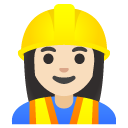
Appearance varies by platform and device. Google Noto, Twemoji, and OpenMoji are open-source.