👩🎤
The Emoji
Woman Singer
U+1F469 U+200D U+1F3A4 · :woman_singer:
Trend 68
Meaning layers
- interpretation
- Used to express a dramatic, performative, or main-character energy moment — often when someone is being extra, serving looks, or feeling themselves like a pop star.
- tiktok usage
- Dropped in comments when someone's audio or lip-sync is flawless, or when a creator is acting out a dramatic monologue. Also used ironically when someone is being theatrically emotional.
- irony level
- 6 / 10
Platform meanings
- meaning
- Signals performance, lip-sync greatness, main-character energy, or theatrical self-expression. Used when someone is absolutely eating their moment.
- trend usage
- Appears in duet chains, audio stitches, and 'POV: you're a pop star' content. Also used in comments like 'SHE ATE 👩🎤' or 'the way she performed that 👩🎤'
- hashtags
- #maincharacter#shesang#performancecheck#womansingervibe#eatandleft
- virality score
- 72 / 100
Cultural meanings
🇺🇸
Western / Gen-Z
Synonymous with 'she's eating,' main-character energy, and being unapologetically expressive — a staple of pop culture commentary and self-hype culture.
🇵🇰
Pakistan & India
Used literally to reference female playback singers, Bollywood vocalists, or classical artists; increasingly used by younger audiences to hype a friend's singing talent.
🌍
Middle East
Used primarily in literal music and performance contexts; younger users influenced by global pop culture use it to hype female artists or express theatrical moods.
🌐
Global Neutral
Universally understood as representing a female singer or performer; safe for cross-cultural communication about music and creative arts.
🇧🇩
Bangladesh
Used to reference female vocalists in Bangla music (like Rabindra Sangeet or folk pop) or to hype a friend's voice note in casual chats.
🇱🇰
Sri Lanka
Used among younger audiences to reference female pop artists or to celebrate local female singers; associated with entertainment and stage performance.
🇨🇳
China
Popular among C-pop and idol culture fans; used to reference female singers on platforms like Douyin and Weibo, often in fan community discussions.
🇯🇵
Japan
Strongly associated with J-pop idol culture, anime singer archetypes, and karaoke culture; used both literally and to express enthusiastic admiration.
🇰🇷
South Korea
Deeply tied to K-pop girl group culture — commonly used in fan accounts, stan Twitter communities, and during music show voting periods.
🇹🇼
Taiwan
Used in Mandopop fan communities and among fans of Taiwanese female artists; also appears in youth-oriented social media expressing performative self-confidence.
🇭🇰
Hong Kong
Associated with Cantopop and female vocalist culture; used literally in entertainment discussions and as a hype emoji for bold, stylish self-expression.
🇵🇭
Philippines
Used to hype the country's strong culture of female singers — OPM artists, reality show contestants, and local pop stars; very common in online fan communities.
🇮🇩
Indonesia
Used in pop music fan communities and casual chats to express admiration for female singers; increasingly adopted in Gen Z ironic and meme contexts.
🇹🇭
Thailand
Associated with T-pop and Thai idol culture; commonly used by fans to express admiration for female performers and in concert-going social posts.
🇻🇳
Vietnam
Used to reference V-pop female artists and to hype friends with good voices; younger users also adopt the global ironic 'main character' usage.
🇲🇾
Malaysia
Used across Malay, Chinese, and Tamil-speaking communities to discuss female musicians; carries a positive, celebratory connotation in entertainment contexts.
🇸🇦
Saudi Arabia
Primarily used in private or youth-oriented chats in reference to international female artists or to express admiration for bold self-expression online.
🇦🇪
UAE
Used widely given the multicultural population — references both international pop stars and regional female artists; popular in entertainment and expat communities.
🇪🇬
Egypt
Associated with the rich tradition of female Arabic vocal performance; used to reference artists and to express admiration for powerful, emotionally resonant singing.
🇹🇷
Turkey
Used in Turkish pop music fan communities and in casual Gen Z conversations to express performative confidence or hype a friend's artistic talent.
🇮🇷
Iran
Used carefully in reference to international or diaspora female artists; younger users employ it privately to express admiration for bold female self-expression.
🇳🇬
Nigeria
Used in Afrobeats and Afropop fan communities to celebrate female artists; also commonly used on social media to hype someone who drops a fire statement.
🇿🇦
South Africa
Tied to the vibrant local music scene; used to celebrate female Amapiano, kwaito, and pop artists, and in youth culture as a general hype emoji.
🇬🇧
UK & Ireland
Used in pop and indie music fan communities and in casual Gen Z chat to signal theatrical moods, self-confidence, or admiration for a bold moment.
🇫🇷
France
Used in chanson, electronic, and pop music fan contexts; also adopted in youth culture to signal artistic identity or dramatic self-expression online.
🇩🇪
Germany
Used primarily in music contexts and by younger users to express performative confidence; less ironic usage compared to English-speaking markets.
🇪🇸
Spain & Italy
Associated with passionate musical expression and performance culture; used both literally for female musicians and as a fun hype emoji in social media.
🇧🇷
Brazil
Very popular in Brazilian pop, funk, and pagode fan communities; used to hype female artists and in casual chats to signal confidence and bold energy.
🇲🇽
Mexico
Used to reference female ranchera, pop, and regional Mexican artists; common in concert-going posts and in youth culture as a self-expression emoji.
🌎
Latin America
Broadly used across Latin American markets to celebrate female musical talent, from reggaeton to salsa; signals empowerment and artistic pride.
🇦🇺
Australia & NZ
Used in pop and indie fan communities and Gen Z social media to signal main-character energy, hype a friend's performance, or celebrate female artists.
How its meaning shifted
- 2010
Did not exist yet — female musician representation in emoji was absent; users relied on music notes or generic person emojis.
- 2015
Still pre-release; the concept of gendered profession emojis was being discussed but not yet implemented in Unicode standards.
- 2020
Newly adopted and growing in use among musicians, music fans, and creative communities; primarily used literally to represent female singers online.
- 2026
Fully integrated into Gen Z vocabulary as a versatile hype and self-expression emoji; carries layers of irony, 'main character' energy, and pop culture resonance beyond its literal meaning.
See it on every platform
Compare with
Adjacent emojis
- Often confused with
- woman dancingwoman artistperson cartwheeling
- Can replace
- microphonemusical notesstar struck
Share & embed
Frequently asked
01What does the 👩🎤 Woman Singer emoji mean?
A woman with a microphone or rock-star styling, representing a female singer, performer, or musician. Often depicted with a star-shaped earring and bold hair reminiscent of David Bowie or rock aesthetics.
02What does 👩🎤 mean on TikTok?
Signals performance, lip-sync greatness, main-character energy, or theatrical self-expression. Used when someone is absolutely eating their moment.
03What does 👩🎤 mean on WhatsApp?
Used to hype up a friend who just shared a voice note, sang something, or is being dramatic in conversation.
04What does 👩🎤 mean in Gen-Z slang?
Used to express a dramatic, performative, or main-character energy moment — often when someone is being extra, serving looks, or feeling themselves like a pop star.
05Is the 👩🎤 emoji safe to use?
Represents female singers, performers, and musicians; used to hype creative expression and celebrate artistic identity.
06What does 👩🎤 mean in texting?
The emoji taps into aspirational identity — the desire to be seen, heard, and celebrated. It can signal self-expression, pride in creativity, or a theatrical emotional release mechanism.
07What is the shortcode for 👩🎤?
The shortcode for Woman Singer is :woman_singer:
08What does 👩🎤 mean in dating?
Sent to someone to imply they've got star quality, or used playfully after dropping a voice message or song recommendation — a subtle way to say 'I'm impressed and charmed by you.'
Safety & usage
- Safe meaning
- Represents female singers, performers, and musicians; used to hype creative expression and celebrate artistic identity.
- Caution
- Rarely weaponized; could theoretically be used sarcastically to dismiss someone as 'dramatic' or 'performative' in a belittling way.
Generally a safe emoji with minimal risk of misuse. Context-dependent sarcasm may occasionally feel dismissive, but this is uncommon.
How it looks across platforms
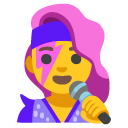


Appearance varies by platform and device. Google Noto, Twemoji, and OpenMoji are open-source.