🦸🏿♀️
The Emoji
Woman Superhero: Dark Skin Tone
U+1F9B8 U+1F3FF U+200D U+2640 U+FE0F · :woman_superhero_dark_skin_tone:
Trend 68
Meaning layers
- interpretation
- Used to celebrate Black women, strong female energy, or anyone who shows up and saves the day. Also used ironically when someone does something impressive or overly competent.
- tiktok usage
- Appears in captions celebrating Black girl magic, baddie energy, or when someone aces something difficult. Also used in 'main character energy' content.
- irony level
- 2 / 10
Platform meanings
- meaning
- Symbol of Black girl power, strong female energy, and iconic moments by women of color. Widely used in empowerment and transformation content.
- trend usage
- Paired with trending sounds about confidence, resilience, or power-up moments. Common in 'glow up' and 'main character era' videos.
- hashtags
- #BlackGirlMagic#WomenWhoInspire#SuperheroVibes#MainCharacterEnergy#EmpoweredWomen
- virality score
- 72 / 100
Cultural meanings
🇺🇸
Western / Gen-Z
Deeply tied to the Black Girl Magic movement and broader Gen Z feminism; widely used to celebrate Black women's strength, resilience, and cultural contributions without irony.
🇵🇰
Pakistan & India
Less commonly used in mainstream conversation but increasingly adopted by younger, internet-savvy audiences to celebrate strong women or female empowerment in a global context.
🌍
Middle East
Usage is limited but growing in progressive online spaces; primarily associated with Western pop culture superhero aesthetics and international women's empowerment discourse.
🌐
Global Neutral
Universally recognized as a symbol of female heroism and strength; the dark skin tone is appreciated by many as an important representation of diversity in digital communication.
🇧🇩
Bangladesh
Relatively rare in everyday usage but appears in social media content influenced by global trends, particularly around International Women's Day or discussions about female role models.
🇱🇰
Sri Lanka
Occasionally used by younger, globally connected Sri Lankans to express admiration for strong women, though the cultural specificity of dark skin tone representation is less locally discussed.
🇨🇳
China
Uncommon in Chinese digital culture where domestic emoji sets are preferred; may appear in communities engaged with Western pop culture or superhero content.
🇯🇵
Japan
Used sparingly, mostly by those familiar with Western diversity discourse; Japan's emoji culture tends to favor more universally ambiguous or kawaii-style icons.
🇰🇷
South Korea
Appears in K-pop fan communities and global pop culture spaces; appreciated by younger Koreans engaged with diversity and representation discussions online.
🇹🇼
Taiwan
Used among progressive, internationally-oriented young Taiwanese internet users; tied to awareness of global diversity and representation movements.
🇭🇰
Hong Kong
Seen in social media posts by those engaged with global culture and activism; relatively niche but positively received in English-language and international circles.
🇵🇭
Philippines
Used in online spaces celebrating strong women and Black culture; Filipino Gen Z users often adopt global emojis enthusiastically, connecting them to local themes of 'fierce' women.
🇮🇩
Indonesia
Appears in younger, globalized Indonesian social media communities, often to express admiration for confident, strong women across cultural lines.
🇹🇭
Thailand
Occasionally used in Thai social media content inspired by global trends; associated with strength and female empowerment without strong local cultural specificity.
🇻🇳
Vietnam
Emerging use among Vietnamese youth engaged with global internet culture; primarily seen in contexts celebrating powerful women or superhero media.
🇲🇾
Malaysia
Used by younger Malaysians in diverse, multicultural digital spaces to celebrate strong women and representation; resonates particularly in inclusive online communities.
🇸🇦
Saudi Arabia
Rarely used in traditional contexts but appears in progressive youth spaces online; the superhero framing is more prominent than the skin tone in local interpretation.
🇦🇪
UAE
Used in cosmopolitan UAE digital spaces, particularly among expat communities and globally connected Emiratis; appreciated as a representation symbol in diverse social circles.
🇪🇬
Egypt
Occasionally appears in Egyptian social media among younger users influenced by global pop culture; primarily framed around female empowerment and heroism.
🇹🇷
Turkey
Used among young Turkish internet users engaged with global feminism and pop culture; associated with strong female characters in entertainment and real-world female heroes.
🇮🇷
Iran
Rare but appears in diaspora and progressive online communities; the imagery of a powerful, capable woman resonates within contexts of female empowerment despite cultural restrictions.
🇳🇬
Nigeria
Highly resonant and enthusiastically used in Nigerian digital culture; deeply tied to celebrating Black excellence, Naija women's strength, and national pride in Black representation.
🇿🇦
South Africa
Strongly used and culturally meaningful in South African social media; connected to celebrating Black women's leadership, community strength, and post-apartheid empowerment narratives.
🇬🇧
UK & Ireland
Widely used in progressive British and Irish digital spaces; associated with celebrating Black British women, intersectional feminism, and diverse representation in media.
🇫🇷
France
Used in French social media primarily by communities engaged with diversity discourse and Afro-French identity; connects to ongoing conversations about representation in French society.
🇩🇪
Germany
Appears in German social media among communities discussing diversity, anti-racism, and representation; used by Afro-German communities and allies to celebrate Black womanhood.
🇪🇸
Spain & Italy
Increasingly used by younger, globally connected Spaniards and Italians engaged with diversity representation; resonates in communities aware of Black cultural contributions.
🇧🇷
Brazil
Widely used and deeply resonant in Brazilian culture given the country's large Afro-Brazilian population; tied to celebrating negra empoderada (empowered Black woman) culture and identity.
🇲🇽
Mexico
Used in Mexican online spaces engaged with Afro-Mexican identity and intersectional feminism; growing awareness of Afro-descendant communities makes this emoji increasingly meaningful.
🌎
Latin America
Adopted across Latin American digital spaces influenced by Black Atlantic culture; resonates particularly strongly in countries with significant Afro-descendant populations celebrating Black women.
🇦🇺
Australia & NZ
Used in Australian and New Zealand progressive and Indigenous solidarity spaces; appreciated as a symbol of diverse representation, particularly in communities advocating for First Nations and Black women.
How its meaning shifted
- 2010
Did not exist; superhero emojis and skin tone modifiers had not yet been introduced to the Unicode standard, and diverse emoji representation was a growing advocacy issue.
- 2015
Skin tone modifiers were introduced to Unicode in 2015, paving the way for diverse emoji; superhero-specific emojis did not yet exist but the groundwork for representation was being laid.
- 2020
Widely adopted following the rise of the Black Lives Matter movement and growing awareness of representation in digital spaces; became a go-to emoji for celebrating Black women and female empowerment.
- 2026
Fully established as a cultural symbol for Black female empowerment, used across all major platforms with strong associations to Black Girl Magic, intersectional feminism, and mainstream pop culture celebrations of diverse heroism.
See it on every platform
Compare with
Adjacent emojis
Share & embed
Frequently asked
01What does the 🦸🏿♀️ Woman Superhero: Dark Skin Tone emoji mean?
A woman superhero with dark skin tone, depicted wearing a superhero costume and cape, representing strength, heroism, and empowerment.
02What does 🦸🏿♀️ mean on TikTok?
Symbol of Black girl power, strong female energy, and iconic moments by women of color. Widely used in empowerment and transformation content.
03What does 🦸🏿♀️ mean on WhatsApp?
Sent to a friend who just did something impressive or came through in a clutch situation, meaning 'you're a superhero.'
04What does 🦸🏿♀️ mean in Gen-Z slang?
Used to celebrate Black women, strong female energy, or anyone who shows up and saves the day. Also used ironically when someone does something impressive or overly competent.
05Is the 🦸🏿♀️ emoji safe to use?
A positive, empowering symbol celebrating Black women, female heroism, and diverse representation in a universally constructive way.
06What does 🦸🏿♀️ mean in texting?
Evokes feelings of representation, resilience, and self-worth. Psychologically linked to identity affirmation and the significance of seeing oneself reflected in powerful symbols.
07What is the shortcode for 🦸🏿♀️?
The shortcode for Woman Superhero: Dark Skin Tone is :woman_superhero_dark_skin_tone:
08What does 🦸🏿♀️ mean in dating?
Used to compliment a partner who is strong, independent, or just handled a tough situation flawlessly. Signals admiration and attraction to confident, capable energy.
Safety & usage
- Safe meaning
- A positive, empowering symbol celebrating Black women, female heroism, and diverse representation in a universally constructive way.
- Caution
- Rarely used toxically; could theoretically be deployed sarcastically to mock or undermine someone's self-perception, though this is uncommon.
Minimal risks; be mindful of performative allyship contexts where the emoji is used without genuine engagement with the communities it represents. Avoid using it to tokenize or appropriate Black culture.
How it looks across platforms
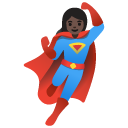
Appearance varies by platform and device. Google Noto, Twemoji, and OpenMoji are open-source.