🦹🏿♀️
The Emoji
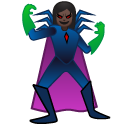
Woman Supervillain: Dark Skin Tone
U+1F9B9 U+1F3FF U+200D U+2640 U+FE0F · :woman_supervillain_dark_skin_tone:
Trend 78
Meaning layers
- interpretation
- Used to express a chaotic, unapologetic, 'bad girl' energy — someone who does what they want, doesn't follow rules, and owns it. Represents self-aware villain behavior, manifesting as flexing on haters or being delightfully petty.
- tiktok usage
- Appears in 'villain arc' content, 'I'm in my villain era' trend videos, and self-deprecating humor about doing something morally questionable but satisfying.
- irony level
- 7 / 10
Platform meanings
- meaning
- The definitive symbol of 'villain era' content — used to signify unbothered, chaotic self-interest energy.
- trend usage
- Appears in 'villain arc' trend videos, 'I woke up and chose chaos' audios, and empowerment-meets-comedy skits where the creator does something petty or bold.
- hashtags
- #VillainEra#VillainArc#DarkFemininity#EvilGirlSummer#UnbotheredVibes
- virality score
- 82 / 100
Cultural meanings
🇺🇸
Western / Gen-Z
Deeply embedded in the 'villain era' trend — used to signal unapologetic self-interest, empowerment, and owning your chaotic energy without guilt. Carries strong positive connotations of confidence and self-advocacy.
🇵🇰
Pakistan & India
Relatively niche usage, primarily among urban, English-speaking Gen Z on Instagram and Twitter who follow Western pop culture trends. May also be used to reference Bollywood antagonist characters or powerful female figures.
🌍
Middle East
Used cautiously among younger, Western-influenced social media users — primarily in Gulf countries — to represent a confident, powerful woman persona, though the 'villain' framing may conflict with more conservative cultural values.
🌐
Global Neutral
Universally understood as representing a female villain or antagonist character, with positive undertones of power and confidence in most digital contexts.
🇧🇩
Bangladesh
Limited usage, mostly among youth who consume Western and Indian content. When used, it typically signals 'badass energy' or references fictional villain characters rather than the nuanced 'villain era' cultural meaning.
🇱🇰
Sri Lanka
Primarily used in entertainment contexts to reference villain characters in film or TV. Among younger social media users familiar with global trends, it occasionally appears in empowerment contexts.
🇨🇳
China
Resonates with the '大女主' (strong female lead) trope popular in Chinese dramas — used to express the energy of a powerful, strategically ruthless woman who wins on her own terms. Popular on Weibo and Xiaohongshu.
🇯🇵
Japan
Connected to the 'akuyaku reijou' (villain noblewoman) isekai genre, extremely popular in manga and anime. Used enthusiastically in fan communities to appreciate well-written female antagonists.
🇰🇷
South Korea
Used in K-pop fan communities and drama discourse to appreciate female villain characters or moments when a female idol exudes fierce, untouchable energy. Tied to 'girl crush' aesthetic culture.
🇹🇼
Taiwan
Similar to South Korea — popular in idol fandom spaces and drama fan accounts where female characters or celebrities display powerful, villainous confidence.
🇭🇰
Hong Kong
Used among entertainment-savvy youth to reference female antagonists in TVB dramas or Hollywood films, increasingly adopted in empowerment contexts among younger users.
🇵🇭
Philippines
Widely used to reference female kontrabidas (villains) in Filipino teleseryes — a deeply familiar archetype. Also adopted in Gen Z empowerment contexts, especially among dark-skinned Filipino users reclaiming bold aesthetics.
🇮🇩
Indonesia
Used primarily to reference sinetron (soap opera) antagonists and increasingly in Gen Z spaces for 'villain era' self-expression. The skin-tone modifier resonates positively with anti-colorism conversations.
🇹🇭
Thailand
Referenced in the context of powerful 'nang rai' (female antagonist) characters from Thai dramas — a beloved archetype. Also used by younger users in empowerment and 'dark queen' aesthetic content.
🇻🇳
Vietnam
Primarily used to reference antagonist characters in dramas or films. Among younger, trend-aware users, the 'villain era' concept is gaining traction through TikTok influence.
🇲🇾
Malaysia
Used in entertainment fan spaces and increasingly in Gen Z empowerment contexts. The dark skin tone modifier is particularly meaningful in conversations about Malay identity and beauty standards.
🇸🇦
Saudi Arabia
Very limited usage — primarily among younger, internationally connected users on Twitter/X. The 'villain' concept may carry stronger negative connotations in culturally conservative contexts.
🇦🇪
UAE
More usage than other Gulf countries due to the cosmopolitan, internationally influenced population — appears in empowerment content among expat and Gen Z communities in Dubai and Abu Dhabi.
🇪🇬
Egypt
Used among youth pop culture fans to reference villain characters in Egyptian or Western media. Occasionally used in feminist spaces to reclaim powerful female archetypes.
🇹🇷
Turkey
Tied to the beloved 'kötü kadın' (bad woman) archetype in Turkish dizis — a culturally resonant character type. Used both in fandom contexts and in Gen Z empowerment content.
🇮🇷
Iran
Used cautiously in private social media spaces — among trend-aware youth, it signals bold, unapologetic femininity which carries additional layers of political resonance given ongoing women's rights movements.
🇳🇬
Nigeria
Strong resonance — dark skin tone representation is deeply appreciated. Used to celebrate powerful, unapologetic Black women energy, tied to Afrobeats culture and 'bad girl' empowerment narratives popular on Nigerian Twitter.
🇿🇦
South Africa
Used in Black excellence and empowerment spaces — the dark skin tone is specifically celebrated. Appears in content celebrating bold Black women and in references to powerful female figures in South African pop culture.
🇬🇧
UK & Ireland
Adopted in line with global Gen Z trends — 'villain era' usage is common, particularly in UK Black cultural spaces on Twitter/X and TikTok where it signals powerful, unbothered energy.
🇫🇷
France
Used among younger, digitally native users familiar with Anglo-American internet culture — primarily in 'bad b' aesthetic contexts and in discussions of female antagonist characters in media.
🇩🇪
Germany
Relatively straightforward usage — primarily for villain character references in gaming and media contexts, with some adoption of the 'villain era' trend among Gen Z users on TikTok.
🇪🇸
Spain & Italy
Used in entertainment contexts and increasingly in Gen Z empowerment content influenced by TikTok trends. The 'villain woman' archetype has strong resonance in telenovela and soap opera cultures.
🇧🇷
Brazil
Heavily tied to the beloved 'vilã' archetype from Brazilian novelas — a culturally iconic character type. Used to hype up women who are bold, fearless, and refuse to be victims. Dark skin tone representation resonates strongly in Afro-Brazilian communities.
🇲🇽
Mexico
Connected to telenovela villain women — a culturally rich archetype. Used to celebrate fierce, powerful women who take no nonsense. Increasingly used in Gen Z spaces for 'villain era' energy expression.
🌎
Latin America
Broadly resonates across Latin America due to the beloved telenovela villain woman archetype. Used to celebrate fierce, unapologetic femininity and increasingly adopted in Gen Z empowerment contexts.
🇦🇺
Australia & NZ
Used in line with global Gen Z internet trends — 'villain era' content is popular on Australian TikTok, and the emoji is frequently used in empowerment and 'chaotic main character' contexts.
How its meaning shifted
- 2010
This emoji did not exist — Unicode 11.0 was not released until 2018. Villain concepts were expressed through generic devil or mask emojis.
- 2015
Still nonexistent. The closest expression of 'villain energy' online used devil horns 😈, skull 💀, or dark heart emojis. The concept of a dedicated villain emoji was still years away.
- 2020
Newly introduced and gaining traction — primarily used in literal comic book / superhero fan contexts and early adoption by users expressing 'I'm the villain in your story' energy on TikTok during lockdown creativity booms.
- 2026
Fully entrenched in 'villain era' and 'dark feminine' internet culture — a go-to emoji for self-empowerment, petty pride, chaotic confidence, and unapologetic self-interest. The dark skin tone modifier carries deliberate cultural and identity significance.
See it on every platform
Compare with
Adjacent emojis
Share & embed
Frequently asked
01What does the 🦹🏿♀️ Woman Supervillain: Dark Skin Tone emoji mean?
A female-presenting supervillain character with dark skin tone, wearing a mask and a dramatic cape or costume associated with comic-book villainy.
02What does 🦹🏿♀️ mean on TikTok?
The definitive symbol of 'villain era' content — used to signify unbothered, chaotic self-interest energy.
03What does 🦹🏿♀️ mean on WhatsApp?
Sent to friends to signal 'I'm being messy/petty right now and I'm proud of it.' Also used when plotting something fun or mischievous.
04What does 🦹🏿♀️ mean in Gen-Z slang?
Used to express a chaotic, unapologetic, 'bad girl' energy — someone who does what they want, doesn't follow rules, and owns it. Represents self-aware villain behavior, manifesting as flexing on haters or being delightfully petty.
05Is the 🦹🏿♀️ emoji safe to use?
Expression of empowerment, confidence, playful mischief, self-advocacy, and embracing a bold/chaotic persona. Positive representation of dark-skinned women in powerful roles.
06What does 🦹🏿♀️ mean in texting?
Tapping into the 'shadow self' concept — users embrace the villain archetype as a form of identity liberation, rejecting societal expectations of being agreeable or likable. Particularly resonant for women and dark-skinned individuals reclaiming power narratives.
07What is the shortcode for 🦹🏿♀️?
The shortcode for Woman Supervillain: Dark Skin Tone is :woman_supervillain_dark_skin_tone:
08What does 🦹🏿♀️ mean in dating?
Used to signal 'I'm dangerously attractive and I know it' — a playful way to hint you're trouble in the best possible way. Pairs with thirst trap photos or bold self-descriptions.
Safety & usage
- Safe meaning
- Expression of empowerment, confidence, playful mischief, self-advocacy, and embracing a bold/chaotic persona. Positive representation of dark-skinned women in powerful roles.
- Caution
- Extremely rare — could theoretically be used in targeted harassment contexts to label someone as a villain or bad person, though this usage is uncommon and not a primary concern.
Generally safe for all ages and contexts. The villain framing is almost universally understood as playful, ironic, or empowering rather than genuinely threatening. No significant toxic usage patterns observed.
How it looks across platforms
Appearance varies by platform and device. Google Noto, Twemoji, and OpenMoji are open-source.