🚶🏿♀️➡️
The Emoji
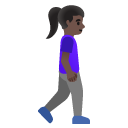
Woman Walking Facing Right: Dark Skin Tone
U+1F6B6 U+1F3FF U+200D U+2640 U+FE0F U+200D U+27A1 U+FE0F · :woman_walking_facing_right_dark_skin_tone:
Trend 58
Meaning layers
- interpretation
- Used to signal walking away from drama, situations, or people without looking back. Embodies the 'unbothered' or 'leaving era' energy. Often paired with captions about moving on, self-improvement, or ignoring negativity.
- tiktok usage
- Appears in 'main character walking away' edits, 'I'm leaving this situation' videos, montages of self-growth journeys, or as a visual metaphor for unbothered energy.
- irony level
- 4 / 10
Platform meanings
- meaning
- Represents a woman confidently moving forward, used heavily in self-improvement, 'that girl' aesthetic, and unbothered main character content.
- trend usage
- Featured in 'walking away from toxic habits' trends, morning routine videos, city walk aesthetic content, and 'leaving my old self behind' transformation videos.
- hashtags
- #thatgirl#walkingaway#maincharacter#unbothered#selfglow
- virality score
- 62 / 100
Cultural meanings
🇺🇸
Western / Gen-Z
Strongly associated with 'unbothered' and 'main character' aesthetics — used to signal leaving toxicity behind and embracing self-growth in an empowered, almost cinematic way.
🇵🇰
Pakistan & India
Used to represent a woman moving independently through public space, which can carry subtle empowerment undertones; also used literally for fitness walks or daily movement.
🌍
Middle East
Interpreted primarily as a woman in motion for exercise or purpose-driven walking; the independence angle is less emphasized publicly but resonates with younger urban women.
🌐
Global Neutral
Universally understood as a woman walking forward — a straightforward representation of movement, progress, and direction applicable across most cultural contexts.
🇧🇩
Bangladesh
Used in practical contexts to indicate walking or commuting; among younger users it carries the 'moving forward' motivational undertone seen in global youth culture.
🇱🇰
Sri Lanka
Primarily used literally for walking or commuting contexts; younger social media users adopt the global 'unbothered woman' interpretation in their feeds.
🇨🇳
China
On platforms like WeChat and Weibo, used to indicate walking exercise (步行) or as part of fitness culture; the Western 'walking away' subtext is less prominent but growing among youth.
🇯🇵
Japan
Used straightforwardly to represent walking as an activity; in younger communities on Twitter/X Japan it can carry the 'moving on' subtext adopted from global emoji culture.
🇰🇷
South Korea
On platforms like KakaoTalk and Instagram, used in fitness contexts and increasingly in 'healing' (힐링) culture posts about walking away from stress and moving toward wellness.
🇹🇼
Taiwan
Used in daily chat to indicate walking or commuting; among younger Taiwanese users it aligns with the global meaning of confident, independent movement.
🇭🇰
Hong Kong
Practical use dominates — indicating walking or transit; among young urban women it also carries empowerment undertones reflecting the city's fast-paced, independent female culture.
🇵🇭
Philippines
Used in casual conversation to indicate walking or leaving; fits well into Filipino social media culture where 'walking away' energy resonates with popular OPM (Original Pilipino Music) themes of resilience.
🇮🇩
Indonesia
Used practically for walking activities and fitness; younger users on TikTok Indonesia adopt the global 'girl boss walking away' narrative in relatable content.
🇹🇭
Thailand
Commonly used for walking activity context and fitness tracking; among youth it merges with 'strong woman' narratives popular in Thai social media culture.
🇻🇳
Vietnam
Used in practical movement contexts and increasingly in self-empowerment posts by younger Vietnamese women navigating modern life on social media.
🇲🇾
Malaysia
Used across messaging apps for walking contexts; among younger Malaysians it connects to global 'glow up' and 'self-improvement' social media trends.
🇸🇦
Saudi Arabia
Among younger Saudi women on platforms like Snapchat and Instagram, this emoji carries empowering undertones of independent movement — particularly resonant post-2018 when women gained more public freedoms.
🇦🇪
UAE
Used in multicultural UAE social media contexts both literally and as an empowerment symbol; resonates strongly with the diverse young expatriate and local female population.
🇪🇬
Egypt
Used for walking or commuting in practical contexts; younger Egyptian women on TikTok and Instagram use it in the global 'walking away from drama' trope.
🇹🇷
Turkey
Commonly used to indicate walking activity; among younger urban Turkish women it fits into 'güçlü kadın' (strong woman) social media narratives about independence.
🇮🇷
Iran
Used in private messaging to indicate walking or movement; among younger Iranian women on Instagram it carries quiet but meaningful undertones of autonomy and forward movement.
🇳🇬
Nigeria
Popular for its representation of a dark-skinned woman in motion — the skin tone modifier resonates deeply with Nigerian users who appreciate accurate representation; used in empowerment and hustle culture content.
🇿🇦
South Africa
The dark skin tone makes this emoji particularly meaningful for South African users; used in empowerment posts, fitness content, and 'walking away from what no longer serves me' narratives.
🇬🇧
UK & Ireland
Used in casual chat for walking contexts and among younger users for 'leaving the situation' humor — often with dry British wit attached.
🇫🇷
France
Used for walking and movement contexts; among younger French users it fits into feminist and independence discourse on social media.
🇩🇪
Germany
Primarily practical use for walking and commuting contexts; in social media among younger Germans it carries the global 'moving forward' motivational meaning.
🇪🇸
Spain & Italy
Used to indicate walking activity; among younger Mediterranean social media users it connects to themes of passionate self-determination and moving on from drama.
🇧🇷
Brazil
Popular in empowerment contexts — Brazilian women on social media use it to signal independence, self-growth, and leaving toxic situations, often paired with fire or crown emojis.
🇲🇽
Mexico
Used in messages about walking or movement; among younger Mexican users on TikTok it aligns with 'chingona' (badass woman) energy and unbothered self-confidence.
🌎
Latin America
Broadly used across Latin America in fitness contexts and increasingly in female empowerment content — the dark skin tone resonates with Afro-Latina communities.
🇦🇺
Australia & NZ
Used casually for walking activity and among younger users for the global 'walking away unbothered' meme format — often with laid-back Aussie/Kiwi humor.
How its meaning shifted
- 2010
This specific emoji combination did not yet exist; general walking person emojis were limited and lacked skin tone modifiers or directional variants.
- 2015
Skin tone modifiers were introduced for emoji; women-specific walking emojis became available but directional variants had not yet been added to the standard.
- 2020
The emoji was primarily used for literal walking contexts and basic 'moving on' metaphors; the 'unbothered woman' meme culture was beginning to popularize its figurative use.
- 2026
Deeply embedded in 'main character,' 'healing era,' and 'that girl' aesthetics; strongly associated with self-empowerment narratives and widely used as a culturally resonant symbol for Black women moving forward on their own terms.
See it on every platform
Compare with
Adjacent emojis
Share & embed
Frequently asked
01What does the 🚶🏿♀️➡️ Woman Walking Facing Right: Dark Skin Tone emoji mean?
A woman walking and facing to the right, with dark skin tone applied via modifier. Represents a woman in motion, moving forward or rightward.
02What does 🚶🏿♀️➡️ mean on TikTok?
Represents a woman confidently moving forward, used heavily in self-improvement, 'that girl' aesthetic, and unbothered main character content.
03What does 🚶🏿♀️➡️ mean on WhatsApp?
Signals leaving a situation, going for a walk, or symbolically exiting a conversation or conflict.
04What does 🚶🏿♀️➡️ mean in Gen-Z slang?
Used to signal walking away from drama, situations, or people without looking back. Embodies the 'unbothered' or 'leaving era' energy. Often paired with captions about moving on, self-improvement, or ignoring negativity.
05Is the 🚶🏿♀️➡️ emoji safe to use?
A woman walking forward — represents movement, independence, progress, exercise, commuting, or metaphorically leaving a negative situation behind.
06What does 🚶🏿♀️➡️ mean in texting?
Psychologically represents agency and forward motion — the act of walking away signals autonomy and self-determination. The dark skin tone adds cultural specificity and representation, which can carry added emotional weight for users who rarely see their skin tone in emoji.
07What is the shortcode for 🚶🏿♀️➡️?
The shortcode for Woman Walking Facing Right: Dark Skin Tone is :woman_walking_facing_right_dark_skin_tone:
08What does 🚶🏿♀️➡️ mean in dating?
Rarely used as a flirting tool; occasionally used to tease someone by implying you're 'walking away' if they don't respond or meet expectations.
Safety & usage
- Safe meaning
- A woman walking forward — represents movement, independence, progress, exercise, commuting, or metaphorically leaving a negative situation behind.
- Caution
- Could theoretically be used in harassment contexts to imply 'keep walking' dismissively, but this is uncommon and highly context-dependent.
No significant safety concerns. The emoji is generally positive and empowering. The dark skin tone modifier ensures representation and is used respectfully by the community.
How it looks across platforms
Appearance varies by platform and device. Google Noto, Twemoji, and OpenMoji are open-source.