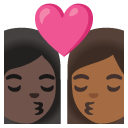
👩🏿❤️💋👩🏾
The Emoji
Kiss: Woman, Woman, Dark Skin Tone, Medium-dark Skin Tone
U+1F469 U+1F3FF U+200D U+2764 U+FE0F U+200D U+1F48B U+200D U+1F469 U+1F3FE · :kiss_woman_woman_dark_skin_tone_mediumdark_skin_tone:
Trend 68
Meaning layers
- interpretation
- Used by Gen Z to express sapphic love, WLW (women-loving-women) relationships, and queer pride, often with an emphasis on celebrating interracial same-sex couples.
- tiktok usage
- Appears in WLW couple content, pride videos, 'day in our life' couple vlogs, and sapphic aesthetic edits.
- irony level
- 1 / 10
Platform meanings
- meaning
- Represents WLW couples, sapphic content, and queer joy, often used in couple reveal or relationship milestone videos.
- trend usage
- Heavily featured in #WLW, #SapphicTikTok, and #PrideTok content; used in 'couple check' and 'girlfriend reveal' trend formats.
- hashtags
- #WLW#SapphicTikTok#PrideTok#QueerCouple#GirlsWhoLikeGirls
- virality score
- 72 / 100
Cultural meanings
🇺🇸
Western / Gen-Z
Widely embraced as a symbol of sapphic love, queer visibility, and intersectional LGBTQ+ identity, celebrated openly on social media.
🇵🇰
Pakistan & India
Largely taboo due to legal and social restrictions on same-sex relationships; rarely used publicly and may face significant negative reception.
🌍
Middle East
Highly sensitive across most of the region where same-sex relationships face legal prohibition; usage is confined to private, closeted, or diaspora queer communities.
🌐
Global Neutral
Recognized internationally as representing a same-sex kiss between two women of darker skin tones; reception varies widely based on local LGBTQ+ acceptance levels.
🇧🇩
Bangladesh
Same-sex relationships are criminalized and socially stigmatized; this emoji would be considered highly inappropriate in mainstream contexts.
🇱🇰
Sri Lanka
While same-sex conduct remains legally ambiguous and socially conservative attitudes prevail, small urban queer communities may use this in private digital spaces.
🇨🇳
China
LGBTQ+ content faces increasing censorship; usage is largely limited to private messaging or VPN-accessible platforms, where queer communities use it quietly.
🇯🇵
Japan
Japan has a nuanced relationship with LGBTQ+ visibility; the emoji is used within queer communities and by younger, progressive demographics without widespread controversy.
🇰🇷
South Korea
Used within Korea's growing but still marginalized LGBTQ+ community; visibility is increasing among younger Koreans though societal acceptance remains mixed.
🇹🇼
Taiwan
Taiwan's status as Asia's LGBTQ+ rights leader means this emoji is used openly and proudly, especially among younger generations celebrating queer love.
🇭🇰
Hong Kong
Used within Hong Kong's queer community, particularly among younger generations, though political and social pressures have complicated LGBTQ+ visibility.
🇵🇭
Philippines
The Philippines has a culturally complex attitude toward LGBTQ+ identity; the emoji is used by queer communities, though same-sex relationships lack legal recognition.
🇮🇩
Indonesia
Highly sensitive due to strong conservative religious norms; usage is restricted to private queer spaces and carries significant social risk if used publicly.
🇹🇭
Thailand
Thailand's relatively visible LGBTQ+ culture means this emoji is used in queer communities, though legal same-sex relationship recognition remains a work in progress.
🇻🇳
Vietnam
Vietnam has removed legal prohibitions on same-sex weddings but social acceptance varies; queer communities use this emoji in private and increasingly public digital spaces.
🇲🇾
Malaysia
Same-sex relationships are criminalized under both civil and religious law; usage is confined to private queer digital communities and carries significant social risk.
🇸🇦
Saudi Arabia
Strictly taboo and potentially dangerous to use publicly given criminalization of same-sex relationships; virtually nonexistent in mainstream digital use.
🇦🇪
UAE
Same-sex relationships are criminalized; usage is extremely limited and confined to private expat or diaspora queer communities using VPNs.
🇪🇬
Egypt
Same-sex relationships face legal and social persecution; this emoji would be considered deeply inappropriate in mainstream contexts.
🇹🇷
Turkey
Turkey's once-progressive LGBTQ+ scene has faced increasing government restrictions; queer communities still use it privately and in diaspora spaces.
🇮🇷
Iran
Same-sex relationships are criminalized; usage is extremely rare and confined to diaspora communities or highly private encrypted communications.
🇳🇬
Nigeria
Same-sex relationships are criminalized under both federal and Sharia law; usage carries serious legal and social risk and is limited to very private queer spaces.
🇿🇦
South Africa
South Africa's constitution enshrines LGBTQ+ rights; this emoji is used openly in queer communities, though rural and traditional communities hold more conservative views.
🇬🇧
UK & Ireland
Embraced openly in a society with strong LGBTQ+ legal protections; used widely by queer women, allies, and in mainstream pride and representation discourse.
🇫🇷
France
Used comfortably within France's generally liberal attitude toward LGBTQ+ rights, particularly in urban youth culture and queer advocacy spaces.
🇩🇪
Germany
Germany's strong LGBTQ+ legal protections and active queer culture mean this emoji is used freely and positively in sapphic and ally communities.
🇪🇸
Spain & Italy
Spain uses it freely given strong LGBTQ+ rights; Italy's more complex Catholic-influenced culture means usage is more common in urban and younger demographics.
🇧🇷
Brazil
Brazil has one of the world's most vibrant LGBTQ+ communities despite political tensions; this emoji is widely used in queer Brazilian spaces and pride culture.
🇲🇽
Mexico
Used openly in Mexico's growing urban LGBTQ+ community, particularly in Mexico City's vibrant queer scene, though regional attitudes vary widely.
🌎
Latin America
Across Latin America, usage varies significantly by country and urban-rural divide; used actively in LGBTQ+ communities but faces conservative pushback in many areas.
🇦🇺
Australia & NZ
Both countries have strong LGBTQ+ legal protections and inclusive cultures; this emoji is used freely and positively in queer and mainstream ally communities.
How its meaning shifted
- 2010
This specific emoji did not exist; representation of same-sex couples in emoji was entirely absent, and LGBTQ+ digital expression relied on text-based symbols.
- 2015
Basic same-sex couple emojis began appearing post-Unicode 8.0, but skin tone combinations for couple emojis were not yet supported; this specific variant did not exist.
- 2020
Unicode 13.1 introduced mixed skin tone support for couple emojis; this specific combination became available and was quickly adopted by WLW communities celebrating both queer and racial representation.
- 2026
Widely recognized as a standard representation of WLW love with intersectional racial identity; regularly used in queer media, brand pride campaigns, and everyday LGBTQ+ digital communication.
See it on every platform
Adjacent emojis
- Often confused with
- kiss marktwo heartsperson gesturing ok
Share & embed
Frequently asked
01What does the 👩🏿❤️💋👩🏾 Kiss: Woman, Woman, Dark Skin Tone, Medium-dark Skin Tone emoji mean?
A kiss emoji depicting two women with dark skin tone and medium-dark skin tone, represented through the sequence of woman + heart + lips + woman with respective skin tone modifiers.
02What does 👩🏿❤️💋👩🏾 mean on TikTok?
Represents WLW couples, sapphic content, and queer joy, often used in couple reveal or relationship milestone videos.
03What does 👩🏿❤️💋👩🏾 mean on WhatsApp?
Sent between women partners to express love and affection; a digital kiss in intimate conversation.
04What does 👩🏿❤️💋👩🏾 mean in Gen-Z slang?
Used by Gen Z to express sapphic love, WLW (women-loving-women) relationships, and queer pride, often with an emphasis on celebrating interracial same-sex couples.
05Is the 👩🏿❤️💋👩🏾 emoji safe to use?
A heartfelt expression of romantic love between two women, used to celebrate queer relationships, WLW identity, and LGBTQ+ visibility.
06What does 👩🏿❤️💋👩🏾 mean in texting?
Carries deep emotional weight for WLW individuals as it represents visibility and validation; seeing one's own identity reflected in an emoji can reinforce a sense of community and self-affirmation.
07What is the shortcode for 👩🏿❤️💋👩🏾?
The shortcode for Kiss: Woman, Woman, Dark Skin Tone, Medium-dark Skin Tone is :kiss_woman_woman_dark_skin_tone_mediumdark_skin_tone:
08What does 👩🏿❤️💋👩🏾 mean in dating?
Used between women in romantic or flirtatious conversations to signal attraction, affection, or a desire to escalate intimacy.
Safety & usage
- Safe meaning
- A heartfelt expression of romantic love between two women, used to celebrate queer relationships, WLW identity, and LGBTQ+ visibility.
- Caution
- In hostile environments, may be used to mock, demean, or sexualize same-sex couples; in some contexts could attract homophobic harassment.
Using this emoji in regions where same-sex relationships are criminalized carries potential real-world risk; users in such areas should be aware of digital surveillance and social consequences.
How it looks across platforms
Appearance varies by platform and device. Google Noto, Twemoji, and OpenMoji are open-source.