👩🏿🏭
The Emoji
Woman Factory Worker: Dark Skin Tone
U+1F469 U+1F3FF U+200D U+1F3ED · :woman_factory_worker_dark_skin_tone:
Trend 28
Meaning layers
- interpretation
- Used to celebrate working-class pride, hustle culture, or ironically to describe grinding through a tough shift at any job — not just factories. Also used in discussions about labor rights and representation.
- tiktok usage
- Appears in 'day in my life' work content, 'I'm built different' hustle posts, and ironic 'this is my life' self-deprecating work videos.
- irony level
- 4 / 10
Platform meanings
- meaning
- Represents hustle, grind, and blue-collar work pride, often used by creators sharing their work-life stories or commenting on labor conditions.
- trend usage
- Appears in hashtags about workers' rights, representation in industry, and 'real job' content countering influencer culture.
- hashtags
- #WorkerPride#BluCollarLife#GrindSeason#RepresentationMatters#LaborRights
- virality score
- 34 / 100
Cultural meanings
🇺🇸
Western / Gen-Z
Seen as a symbol of blue-collar pride and representation, especially in conversations about diversity in manufacturing and labor rights. Often used ironically in memes about grinding through a tough job.
🇵🇰
Pakistan & India
Represents women in industrial labor, which carries both respect and social complexity given traditional gender roles; increasingly used in urban progressive circles to champion women's workforce participation.
🌍
Middle East
Carries a nuanced meaning, representing women breaking into traditionally male-dominated industries; used more in advocacy and social media activism than casual conversation.
🌐
Global Neutral
Universally understood as a woman working in a factory or industrial setting, used to represent labor, manufacturing, and blue-collar professions regardless of cultural context.
🇧🇩
Bangladesh
Highly relevant given the large garment manufacturing industry; used to represent the millions of women working in factories, often in discussions about workers' rights and fair wages.
🇱🇰
Sri Lanka
Associated with women in export manufacturing zones; used in labor rights conversations and to represent female industrial workers who form a significant part of the economy.
🇨🇳
China
Resonates with the legacy of women's participation in industrial production; used respectfully to represent female factory workers in a culture that historically honored labor contributions.
🇯🇵
Japan
Used to acknowledge women in manufacturing and industry, though Japan's corporate culture more commonly uses office-worker emojis; carries a sense of respect for physical labor.
🇰🇷
South Korea
Associated with the history of women in Korean manufacturing industries; used in labor rights discussions and to celebrate women in non-traditional industrial roles.
🇹🇼
Taiwan
Used in contexts celebrating Taiwan's manufacturing heritage and women's role in it; appears in progressive discussions about gender equity in the workforce.
🇭🇰
Hong Kong
Used in labor advocacy contexts, particularly in discussions about workers' rights and gender representation in industrial sectors.
🇵🇭
Philippines
Represents the many Filipino women in manufacturing and overseas work; used to celebrate OFW (Overseas Filipino Worker) culture and the dignity of industrial labor.
🇮🇩
Indonesia
Associated with women in textile and manufacturing industries; used in labor rights conversations and to represent the large female manufacturing workforce.
🇹🇭
Thailand
Represents women in Thailand's significant manufacturing sector; used in discussions about labor conditions, workers' rights, and gender in industry.
🇻🇳
Vietnam
Highly relevant given Vietnam's large female manufacturing workforce; used respectfully to represent women in electronics and textile production industries.
🇲🇾
Malaysia
Used to represent women in Malaysia's diverse manufacturing sector; appears in discussions about labor rights, foreign worker conditions, and gender in industry.
🇸🇦
Saudi Arabia
Carries progressive connotations as women entering the workforce is a relatively recent social shift; used in conversations about Vision 2030 and women's economic empowerment.
🇦🇪
UAE
Used in professional and social media contexts celebrating workforce diversity and women's participation in non-traditional industries within the UAE's evolving social landscape.
🇪🇬
Egypt
Represents women in Egypt's textile and manufacturing sectors; used in labor rights discussions and to celebrate women who challenge traditional gender norms in the workplace.
🇹🇷
Turkey
Associated with women in Turkey's significant textile and manufacturing industries; used in labor rights and feminist discourse about women's economic independence.
🇮🇷
Iran
Used in underground or activist contexts to represent women's right to work and economic independence; carries quiet but powerful connotations of resistance.
🇳🇬
Nigeria
Represents women in manufacturing and production industries; used to celebrate hustling women and entrepreneurial spirit in a culture that deeply values hard work and resilience.
🇿🇦
South Africa
Used in labor rights contexts and to represent women in South Africa's mining and manufacturing sectors, often tied to broader conversations about racial and gender equity.
🇬🇧
UK & Ireland
Used in working-class pride contexts and labor movement discussions; resonates in communities celebrating the history of women in British and Irish industrial sectors.
🇫🇷
France
Associated with labor rights and the proud tradition of French industrial workers; used in discussions about gender equity in manufacturing and the rights of workers.
🇩🇪
Germany
Fits into Germany's strong culture of respecting skilled trade and manufacturing work; used professionally and in labor discussions to represent women in the Mittelstand industrial sector.
🇪🇸
Spain & Italy
Represents women in manufacturing and textile industries with historical significance; used in labor rights discussions and to celebrate working-class heritage in Southern Europe.
🇧🇷
Brazil
Associated with women in Brazil's diverse manufacturing sector; used in labor rights conversations and to celebrate the resilience and contribution of working-class women.
🇲🇽
Mexico
Highly resonant given Mexico's large maquiladora factory sector employing many women; used to honor working women and in discussions about labor rights and fair wages.
🌎
Latin America
Broadly represents the millions of women working in Latin American manufacturing and export industries; used in labor rights advocacy and to celebrate women's economic contributions.
🇦🇺
Australia & NZ
Used in contexts celebrating women in trades and manufacturing; resonates in discussions about gender diversity in blue-collar sectors and working-class pride.
How its meaning shifted
- 2010
This specific emoji did not exist in 2010 as skin tone modifiers and profession emojis were not yet introduced; general worker emojis were rarely used.
- 2015
The factory worker emoji was introduced around this period but without skin tone and gender diversity; representation was limited and usage was primarily functional.
- 2020
Following increased social awareness around racial justice and representation, this emoji gained traction in discussions about diversity in the workforce, labor rights, and celebrating women of color in industry.
- 2026
Widely used in labor advocacy, diversity and inclusion content, and working-class pride communities; increasingly appears in mainstream social media posts celebrating women in trades and manufacturing.
See it on every platform
Compare with
Adjacent emojis
- Often confused with
- woman construction worker dark skin tonewoman mechanic dark skin tonefactory
Share & embed
Frequently asked
01What does the 👩🏿🏭 Woman Factory Worker: Dark Skin Tone emoji mean?
A woman working in a factory or industrial setting, shown with dark skin tone. Combines the woman emoji, dark skin tone modifier, and factory worker emoji.
02What does 👩🏿🏭 mean on TikTok?
Represents hustle, grind, and blue-collar work pride, often used by creators sharing their work-life stories or commenting on labor conditions.
03What does 👩🏿🏭 mean on WhatsApp?
Used to tell someone you're at work or going to a tough shift; signals being busy or grinding through the day.
04What does 👩🏿🏭 mean in Gen-Z slang?
Used to celebrate working-class pride, hustle culture, or ironically to describe grinding through a tough shift at any job — not just factories. Also used in discussions about labor rights and representation.
05Is the 👩🏿🏭 emoji safe to use?
Represents women working in factories or industrial settings with dark skin tone; used for representation, labor rights advocacy, and celebrating working-class identity.
06What does 👩🏿🏭 mean in texting?
Evokes a sense of dignity in labor and working-class identity. Can carry empowerment for those who see themselves represented, while also triggering reflection on systemic inequalities in the workplace.
07What is the shortcode for 👩🏿🏭?
The shortcode for Woman Factory Worker: Dark Skin Tone is :woman_factory_worker_dark_skin_tone:
08What does 👩🏿🏭 mean in dating?
Rarely used in flirting contexts; may occasionally be used playfully to say 'I'm a hard worker and I'll take care of things' or as a self-deprecating joke about a tough job.
Safety & usage
- Safe meaning
- Represents women working in factories or industrial settings with dark skin tone; used for representation, labor rights advocacy, and celebrating working-class identity.
- Caution
- Could theoretically be used in a demeaning context to demean someone's profession or reinforce classist stereotypes, though this is uncommon.
Generally a safe emoji with no widely-known toxic or NSFW uses. Care should be taken not to use it in contexts that demean blue-collar work or reinforce racial stereotypes about labor.
How it looks across platforms
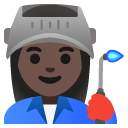


Appearance varies by platform and device. Google Noto, Twemoji, and OpenMoji are open-source.