🧚🏿♀️
The Emoji
Woman Fairy: Dark Skin Tone
U+1F9DA U+1F3FF U+200D U+2640 U+FE0F · :woman_fairy_dark_skin_tone:
Trend 62
Meaning layers
- interpretation
- Used to express magical self-confidence, unbothered energy, and the idea of moving through life with effortless grace and a touch of mischief. Often paired with 'not my problem' or 'that's the magic' vibes.
- tiktok usage
- Appears in transformation videos, confidence montages, and 'main character' aesthetic content. Used to signal that someone is ethereal, unbothered, or doing things their own magical way.
- irony level
- 3 / 10
Platform meanings
- meaning
- Signals ethereal, magical, unbothered energy. Used in transformation reveals, glow-up videos, and Black girl magic celebration content.
- trend usage
- Frequently used in #BlackGirlMagic and #MainCharacter trends; appears in audio-synced fantasy aesthetic videos and 'living in my own world' themed content.
- hashtags
- #BlackGirlMagic#FairyVibes#MainCharacterEnergy#MelaninMagic#DarkSkinMagic
- virality score
- 68 / 100
Cultural meanings
🇺🇸
Western / Gen-Z
Strongly embraced as a symbol of 'Black Girl Magic' and dark-skinned representation in fantasy spaces; used celebratorily and with pride by young Black women in the West.
🇵🇰
Pakistan & India
Less commonly used; when it appears it may be appreciated as a fantasy creature emoji but the skin tone significance is less culturally prominent than in Western contexts.
🌍
Middle East
Used minimally; the fantasy connotation is understood but the skin tone modifier carries less specific cultural weight, sometimes used generically for magical themes.
🌐
Global Neutral
Broadly interpreted as a magical fairy figure; the dark skin tone modifier is seen as a representation choice, and its use is generally positive across neutral global contexts.
🇧🇩
Bangladesh
Rarely used in mainstream communication; when used, it's typically in creative or fantasy contexts without strong awareness of its cultural significance in Black communities.
🇱🇰
Sri Lanka
Occasionally used in fantasy and creative circles; the fairy meaning dominates and the skin tone modifier is seen as a representation feature rather than carrying specific cultural weight.
🇨🇳
China
Used in fantasy-themed content and creative communities; the specific Black cultural significance is largely absent but the magical aesthetic is appreciated in fantasy art circles.
🇯🇵
Japan
Embraced in anime and fantasy fan communities as a representation of dark-skinned magical characters; Afrofantasy aesthetics have a small but growing following in Japanese fanart communities.
🇰🇷
South Korea
Found in K-drama fantasy fan communities and among Koreaboppers who appreciate diverse representation; increasingly used as international cultural awareness grows.
🇹🇼
Taiwan
Used primarily in fantasy and creative contexts; appreciated in illustration and character design communities where dark-skinned fantasy characters are increasingly popular.
🇭🇰
Hong Kong
Seen in international-facing creative and pop culture communities; the emoji is understood as a diverse fairy representation, occasionally used in fantasy fan art discussions.
🇵🇭
Philippines
Used in fantasy fan communities and among Filipinos who engage with international Black culture online; carries both magical and representation significance among socially aware users.
🇮🇩
Indonesia
Primarily used in fantasy and creative contexts; the skin tone significance is understood by globally connected young users but less prominent in everyday communication.
🇹🇭
Thailand
Occasionally used in fantasy aesthetics and K-pop/Western pop culture crossover spaces; the dark skin tone modifier has growing recognition among younger, globally connected Thais.
🇻🇳
Vietnam
Used sparingly in fantasy-themed content; among younger, internationally connected Vietnamese users there is growing awareness of its Black cultural significance.
🇲🇾
Malaysia
Used in fantasy and creative communities; Malaysian users with awareness of global Black culture may use or appreciate it for its representation significance.
🇸🇦
Saudi Arabia
Rarely used; when it appears it's typically in fantasy-themed content, with the cultural significance of the skin tone modifier being less recognized in mainstream usage.
🇦🇪
UAE
In the UAE's diverse multicultural environment, it may be used by Black expat communities with full cultural awareness, while other communities use it more generically as a fairy symbol.
🇪🇬
Egypt
Used in fantasy and creative digital communities; among younger, globally connected Egyptians there is some awareness of Black representation themes.
🇹🇷
Turkey
Found in fantasy fan art and creative circles; the Black cultural significance is gradually becoming more recognized among globally connected Turkish youth.
🇮🇷
Iran
Rarely used in mainstream contexts; appears in fantasy-themed creative communities where the magical aesthetic is the primary focus.
🇳🇬
Nigeria
Enthusiastically used with full cultural pride — represents Black excellence, feminine magic, and Afrofantasy aesthetics; deeply resonant in Nigerian digital culture and social media.
🇿🇦
South Africa
Used proudly to celebrate dark-skinned magical femininity; resonates strongly in South African Black culture as a symbol of beauty, power, and Afrofuturism.
🇬🇧
UK & Ireland
Embraced by Black British communities as a symbol of Black Girl Magic; used in mainstream UK pop culture contexts that celebrate diversity in fantasy and creative spaces.
🇫🇷
France
Used in Afropéen communities and among French Black youth to celebrate dark-skinned representation; appears in discussions of diversity in French media and fantasy culture.
🇩🇪
Germany
Used in diversity advocacy and Black German communities; appears in creative spaces embracing Afrofuturism and in discussions of representation in German fantasy media.
🇪🇸
Spain & Italy
Used in Afroeuropean communities and among younger, globally aware users who follow international Black culture; the fairy meaning is primary for most users.
🇧🇷
Brazil
Used warmly in Afro-Brazilian communities to celebrate Black feminine magic and connection to Afrofantasy; Brazil's strong Afro-descendant culture gives this emoji meaningful resonance.
🇲🇽
Mexico
Used by socially aware young Mexicans engaged with Afro-Latin identity and international Black culture; primarily seen as a fantasy symbol by broader mainstream users.
🌎
Latin America
Used in Afro-Latin communities across the region to celebrate Black femininity and magic; broader Latin American users engage with it primarily as a fantasy aesthetic symbol.
🇦🇺
Australia & NZ
Used by Black Australian and Black New Zealand communities with full cultural awareness; mainstream Australian users appreciate it as a representation-forward fantasy emoji.
How its meaning shifted
- 2010
This emoji did not exist in 2010; the fairy emoji and skin tone modifiers had not yet been introduced to the Unicode standard.
- 2015
The base fairy emoji was not yet available; skin tone modifiers were just being introduced to Unicode 8.0 in 2015 but the fairy specifically was not yet part of the set.
- 2020
Gained significant traction as the Black Girl Magic movement grew online; used heavily in TikTok and Instagram to celebrate dark-skinned Black women in magical and fantasy aesthetics.
- 2026
Firmly established as a symbol of Black feminine empowerment and Afrofantasy culture; embedded in diverse fantasy representation discourse and used across generations of Black digital creators.
See it on every platform
Compare with
Adjacent emojis
Share & embed
Frequently asked
01What does the 🧚🏿♀️ Woman Fairy: Dark Skin Tone emoji mean?
A fairy depicted as a woman with dark skin tone, featuring wings and magical connotations, combining the woman emoji, fairy emoji, and dark skin tone modifier.
02What does 🧚🏿♀️ mean on TikTok?
Signals ethereal, magical, unbothered energy. Used in transformation reveals, glow-up videos, and Black girl magic celebration content.
03What does 🧚🏿♀️ mean on WhatsApp?
Sent between friends to hype each other up — 'you're magical, girl' energy. Also used when someone pulls off something impressive or unexpected.
04What does 🧚🏿♀️ mean in Gen-Z slang?
Used to express magical self-confidence, unbothered energy, and the idea of moving through life with effortless grace and a touch of mischief. Often paired with 'not my problem' or 'that's the magic' vibes.
05Is the 🧚🏿♀️ emoji safe to use?
A positive, celebratory symbol of magical femininity, Black representation in fantasy, and empowered self-expression used widely across social platforms.
06What does 🧚🏿♀️ mean in texting?
This emoji taps into the psychological need for representation and fantasy escapism. For many dark-skinned users, it carries deep resonance as a symbol of seeing their likeness in magical, positive imagery — reinforcing self-worth and creative identity.
07What is the shortcode for 🧚🏿♀️?
The shortcode for Woman Fairy: Dark Skin Tone is :woman_fairy_dark_skin_tone:
08What does 🧚🏿♀️ mean in dating?
Used flirtatiously to suggest someone has a magical, enchanting presence. Often sent to someone you find spellbindingly attractive — 'you've got me under a spell' energy.
Safety & usage
- Safe meaning
- A positive, celebratory symbol of magical femininity, Black representation in fantasy, and empowered self-expression used widely across social platforms.
- Caution
- Extremely rarely weaponized; could theoretically be used in a condescending 'living in a fairy tale' dismissal but this is not a common pattern.
No significant toxic usage patterns identified. The emoji is overwhelmingly used positively. Cultural appropriation concerns exist if used mockingly in contexts that diminish Black cultural spaces, but such usage is rare.
How it looks across platforms
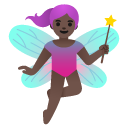
Appearance varies by platform and device. Google Noto, Twemoji, and OpenMoji are open-source.